
December 12, 2025 — One of PEF’s top priorities when it comes to improving working conditions and protecting its members at DOCCS is the delivery of quality programming to incarcerated individuals. Currently, DOCCS offers 97 different programs to prepare individuals for a return to society. They range from hands-on training in marketable skills like barbering, to adult education and aggression replacement training,
At a legislative hearing in May 2025 that was called after the death of incarcerated individual Robert Brooks following a recorded beating at the hands of correctional officers, President Wayne Spence told lawmakers that programming not only helps lower the rate of recidivism, but it also helps mitigate issues related to solitary confinement.
“Some of the best outcomes when being moved out of solitary confinement are programming,” President Spence said. “(When correctional facilities are fully staffed) there is either one-on-one, individual therapy sessions or group sessions all the time.”
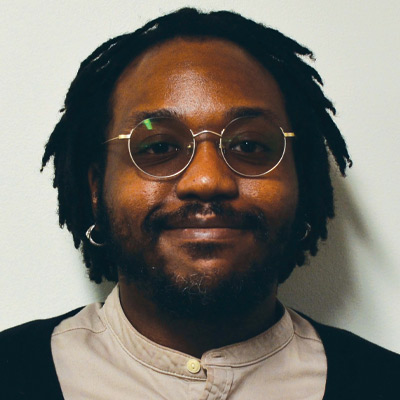
Fifteen years ago, a now popular horticulture program designed to train individuals to grow, transplant, prune, cultivate and fertilize plants arrived in DOCCS facilities. Retired PEF member Steve Drake helped individuals begin their journey working with plants.
“We are teaching the population to build life skills relative to what they need to do to function in the workplace,” said Drake, “as well as trade knowledge relative to the variety of trades offered in the horticulture program, one of them being in the greenhouse industry.”
Drake retired in September after working as an educator at DOCCS for more than 30 years. He started as a vocational instructor in 1994 before becoming an educational supervisor in 2019. As a PEF member, Drake served on the executive board and co-chaired the DOCCS Labor-Management Committee.
Drake said educators are on the frontline working closely with incarcerated individuals in order to rehabilitate their lives and prepare them for reentry into society. It is often through programming that these individuals become successful once they leave DOCCS facilities.
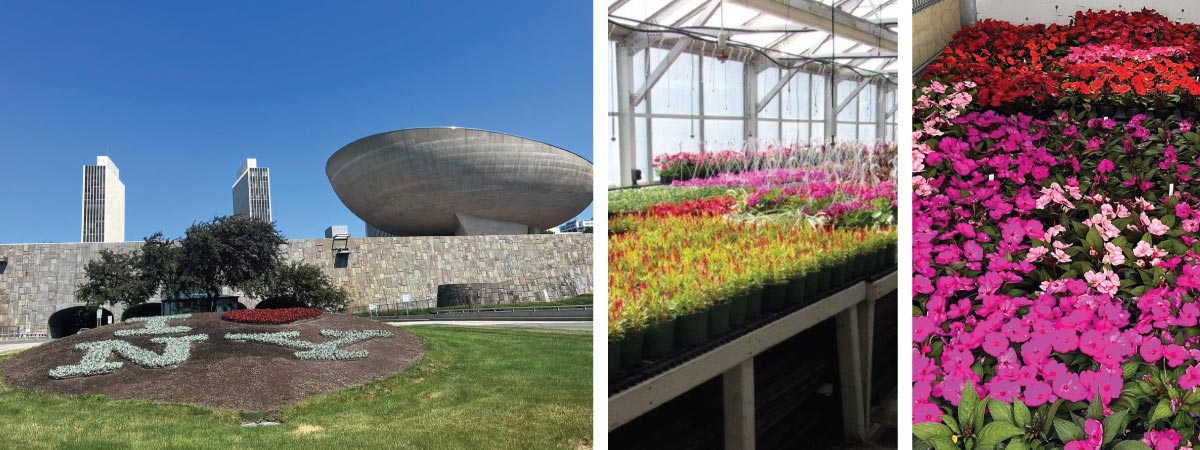
The horticulture program offers a chance for individuals to learn how to work in greenhouses, as groundskeepers, as plant propagators, and even landscapers and pavers. As part of the program, the flowers produced by incarcerated individuals help to decorate state buildings across New York including the Capitol Building and the Governor’s Mansion in Albany, various New York State Trooper’s Barracks, and the State Fairgrounds in Syracuse.
“The program has continued to grow over the years,” said Drake. “We started growing for the Fairgrounds about seven years ago. We basically grow for every central office in Albany.”
A more recent off shoot of the horticulture program is the nationwide Harvest Now program. The program began nationwide in 2008, focusing on food scarcity in the United States by encouraging correctional facilities, schools and religious institutions to plant, grow and donate food from their grounds to local shelters and food banks. In 2016, New York State correctional facilities joined the Harvest Now program and14 DOCCS facilities currently participate.
“This is really what I want people to know about the programs we provide at DOCCS,” said Drake. “The agency as a whole continues to try to provide the ability for the population to be successful when they go home through these programs. We want them to do well.”
Even though Drake is retired, he plans to support PEF’s advocacy efforts at DOCCS. He believes that as long as DOCCS remains so short-staffed, the needs of everyone who works behind the walls will be great. He is hopeful that PEF and DOCCS will continue to have a good working relationship and build a better, safer future.
“My work with the union and the department—as hard as the work was that we did—we’ve always had the ability to have good dialogue. That doesn’t mean we won every battle, but we have always been able to express our concerns to the department and try to resolve things together,” said Drake. “Sometimes we’re bound by law, and the dynamics at DOCCS have changed in the last few years relative to that, but we’re still trying to come up with solutions to make it a safer place for our members, which is the union’s biggest concern.”
Editor’s Note: Tanya Oliver, a teacher at Elmira Correctional Facility, and Lori Greenizen, an Offender Rehabilitation Coordinator at Cape Vincent Correctional, now co-chair the DOCCS Labor-Management Committee. Find your agency’s L-M chairs, here.