

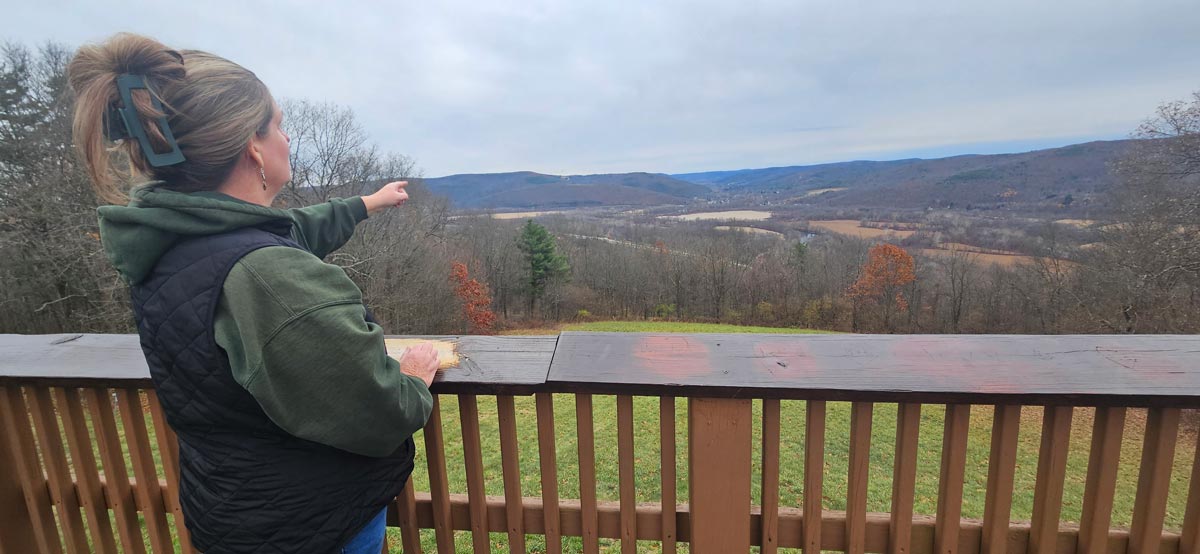
 January 15, 2025 — Looking out across the landscape from the overlook at Newtown Battlefield State Park in Elmira, I saw a stunning vista of trees, water, and roadways — but PEF member Tori Srnka sees much more. She sees possibilities.
On Aug. 29, 1779, thousands clashed on the hillside during the Battle of Newtown, the only large-scale battle of the Sullivan-Clinton Campaign during the Revolutionary War. The battle was typically shared as being justified punishment against several Haudenosaunee (Iroquois Confederacy) Nations that had sided with the British and attacked frontier settlements.
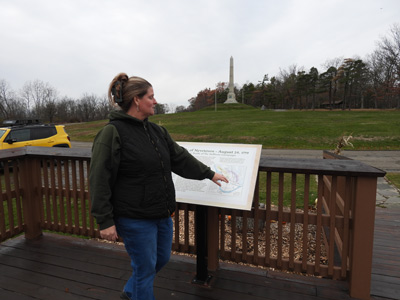
While a monument to General John Sullivan, erected in 1912, stands on the grounds and several interpretive signs line the scenic overlook, the site offers little additional information to fully tell its story.
Srnka, an Interpretive Programs Assistant with the Office of Parks, Recreation, and Historic Preservation (OPRHP) and a Recreation and Leisure Studies graduate, hopes to change that. The park has started the process to establish a comprehensive plan and has been collaborating with American Battlefield Trust to expand the park’s boundaries through strategic land acquisitions — more than 378 acres of additional core battlefield have already been preserved.
 “Currently, six interpretative panels share the history of the site: four regarding this part of the Revolutionary War, one on the history of the monuments that have been erected (and fallen), and another on the unique history of Civilian Conservation Corps Company 1251c, including the Main Lodge and other mid-1930s construction,” Srnka said. “But little is shared about the battle’s impact on the Haudenosaunee Nations, nor their perspective on the war or their deep, centuries-long history in the region.
“The agency recently hired a new Interpreter of Native American History working at our Division for Historic Preservation at Peebles Island State Park,” she said. “She’s a wonderful addition and we are so happy to have her working with Newtown as we move forward in sharing Our Whole History — an important agency initiative. The planning team also hopes to add a consultant from the Seneca Nation; having representation throughout the process and beyond is extremely important.”
The newly preserved land includes historically significant portions of the core battlefield, including the breastworks and major troop movements. The expansion creates an opportunity to interpret battle strategies from all sides and illustrate what the landscape may have looked like nearly 250 years ago. Srnka emphasized the importance of sharing not only what happened at the Battle of Newtown, but also the stories before, after, and to come.
Future changes could allow for a visitor center or even a museum to enhance the experience. Srnka hopes local families who may still have artifacts passed down through generations might eventually be willing to donate or loan items for display. Currently, OPRHP has no artifacts from the battle in its collection.
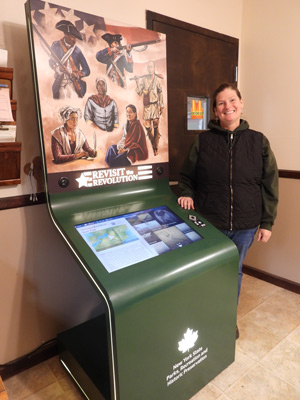
Newtown is also one of a small number of sites in New York equipped with a digital Revisit the Revolution kiosk — an interactive touchscreen featuring Revolutionary War battlefields and historic sites across the state. Visitors can access the kiosk in the small Welcome Center during warmer months; it is stored in winter due to climate-control requirements. Thanks to funding from the New York State 250th American Revolution Commemoration Commission, work is underway to make the kiosk’s information available online.
“This is one of 20 kiosks in New York, and we are lucky to have one of them,” Srnka said. “It supports many learning styles — you can explore by site list or map, by story themes like people, politics, or battles, or through a timeline.”
Srnka said the kiosk aligns with the vision for the park: offering an inclusive history that tells many sides of the story, not just that of the victors.
“We are also working with grant funds secured by the American Battlefield Trust through the National Park Service’s American Battlefield Protection Program on a NYS Liberty Trail App,” she said. “The app will feature three Revolutionary War battlefields — Newtown, Oriskany, and Bennington. Each site will have 12 to 15 stops sharing key points and places. For fans of augmented reality, the app will give visitors a virtual glimpse into the past. It’s going to be amazing — you’ll walk around and into an 18th-century Seneca cabin as it would have looked.”
The app will guide visitors through the battlefield, either on-site using their phones or from home. It will include artistic renderings, photography, stories, and written history tied to specific locations — many selected with Srnka’s input.
Improving accessibility
Not all improvements are in the planning stages — some are already in place.
The New York State Parks’ Enhanced Visitor Experience (EVE) Program allows visitors to round up their camping or day-use fees through the Reserve America system, with funds supporting beautification, accessibility upgrades, programming, educational materials, and more.
Srnka successfully applied for EVE funding to improve accessibility at Newtown, resulting in three new ADA fire rings, 10 standard fire rings, four ADA-accessible picnic tables, and nine accessible shelf-swivel grills.
Newtown received additional funding through the agency’s “All Are Welcome” program to install an EnChroma viewer at the scenic overlook, enabling visitors with color blindness to more fully experience the landscape. While those with typical color vision see more than one million hues, the 350 million people worldwide with color blindness see only an estimated 10 percent of them.
“We’ll also complete the vision of a total campground improvement with all remaining campsites and picnic areas being outfitted with brand new fire rings and picnic tables,” Srnka said. “We’re upgrading the exterior features of a cabin, two campsites and two picnic areas to be more accessible, and adding new outdoor amenities at the other campsites and cabins. It’s truly something for everyone!”
Srnka is excited to share these improvements with the community when the site hosts an All Are Welcome Day event in the summer of 2026, where the local community will be able to visit and experience a fun-filled day of accessible programs hosted by the regional Environmental Education team.
“I love that working for OPRHP gives me a variety of things to do on any given day,” Srnka said. “I may be helping patrons with information about the park or local area; managing public water systems or repairing small plumbing issues; troubleshooting electrical line failures while maintaining public safety; planting trees; or planning events like First Day Hikes or I Love My Park Day. It’s a diverse role and never a boring day.”
Her passion for Newtown is evident.
“At the end of the planning process, I hope we are sharing more of the whole history of the site — hearing and interpreting all perspectives, including both its Revolutionary War and Civilian Conservation Corps significance,” she said. “I hope we expand recreational opportunities, protect our unique natural resources, improve the visitor experience, and most importantly, ensure the site becomes what the public wants it to be.”