

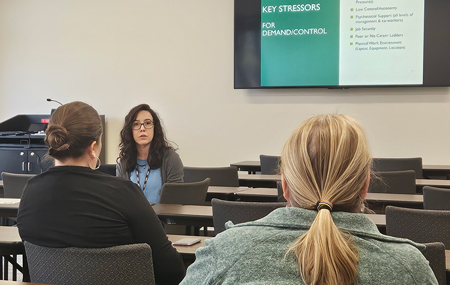
 May 21, 2026 — As a union, PEF takes on every level of workplace health and safety – from violence at facilities, to ergonomics, to occupational stress. Member leaders can request training for their constituents, such as the “Overview of Occupational Stress Impacts and Interventions” that took place at PEF headquarters on April 21.
Organized by Office of Information Technology Services (ITS) Health and Safety Chair Prakash Lal and Division 357 (Statewide ITS) Council Leader Christopher Ford, the training outlined the basics of occupational stress (defining stressors, stress, and strain); examples of job strain (high job demands, low job control, low support); and the difference between chronic and acute stress.
“Occupational stress and its impact on daily life is very common, and it is especially pronounced for employees working for New York State,” said Lal. “Our members are routinely expected to do more with less, operate under constant pressure, and meet deadlines that often feel like they were due yesterday.”
Ongoing organizational changes, staffing shortages, and inconsistent or inefficient workflows only make matters worse.
“ITS provides services to more than 50 state entities,” Ford said. “While we have a few ITS home locations, much of our staff is spread across the state and embedded in the agencies we serve. Our members experience not only the traditional stress conditions that you would expect in the IT industry but also stress from the agencies hosting us.
“We are alongside staff from the Department of Health, Department of Corrections and Community Supervision, the Office of Mental Health, the Office of Temporary and Disability Assistance, the Office of Children and Family Services, and many more,” he said. “On any day some of us will be at our desks all day while others are traveling two hours for a service call to keep a program operational.”
With multiple reporting lines, different rules, and the required fast pace of the IT world, members may not always recognize they need help or know what options are available to them, Ford said.
Working through the PEF/ITS Health & Safety Committee, Lal said the goal has been to ensure members are aware of these realities and empowered to deal with them before they escalate. The committee offers training on ergonomics, stress, and safe driving, aimed at supporting healthier and safer workplaces.
“Our Health & Safety Committee offers this course and works with other contract- supported programs, like the Employee Assistance Program, to aid our members and move toward a healthier work environment,” he said.
Lal summed it up well: “Over time, unmanaged stress can negatively affect both personal wellbeing and job performance.”
Editor’s note: PEF members who work for any agency and are experiencing occupational stress are encouraged to reach out to their union steward, who may direct them to a local health and safety committee, if one exists. If it doesn’t, members should contact PEF Health & Safety at healthandsafety@pef.org and consult this Factsheet for helpful information and resources.