

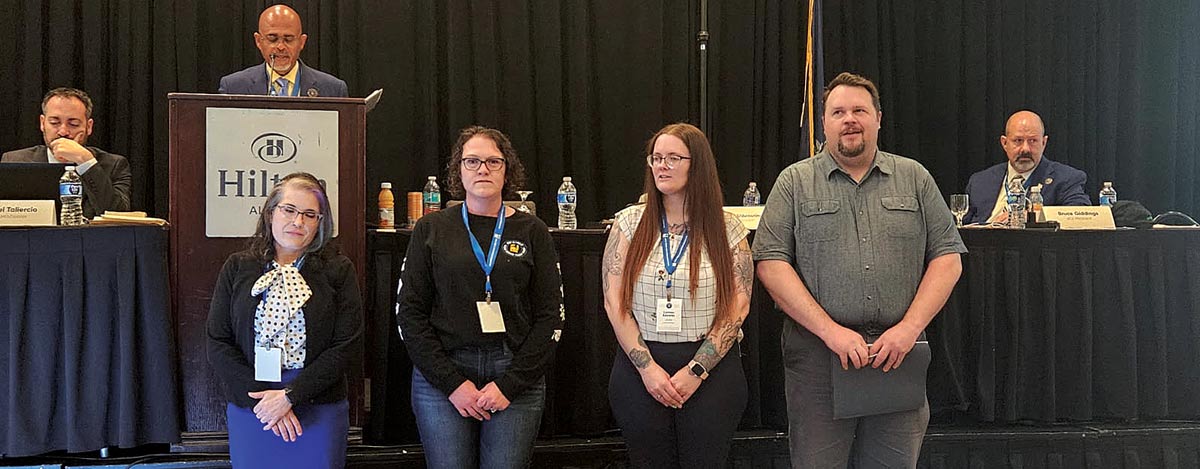
June 12, 2026 — The PEF Executive Board met on June 4 and 5 in Albany, kicking off the quarterly meeting with a presentation on reforms to the pension plan, a Q&A with Civil Service Commissioner Timothy Hogues, and updates on COPE and member engagement.
On day one, members marched during their lunch hour from the Albany Hilton up to West Capitol Park where about 600 members rallied for a fair contract. Day two brought word of a conceptual agreement between the union and the State Office of Employee Relations on a five-year contract with across-the-board wage increases, major dental gains, and other economic wins.

Tier 6 reforms
Conversations continue to swirl around the differing benefits secured in the Tier 6 plan, with frustration and misconceptions boiling over.
“Given the overall cost to repair these plans, no one ever said fixing Tiers 5 and 6 would happen overnight,” said Legislative Director Patrick Lyons. “We got something done.”
Careful consideration went into where to focus lobbying efforts this year, with more money in members’ pockets the top priority. That’s why PEF fought for a reduction in employee pension contributions rather than retirement at age 58 following 30 years of service, which is what some teachers received. While teachers tend to start service in their early 20s, the average age of entry into service for a state employee is 36 years old. With Tier 6 only created in 2012, members will need to work until 2042 to reach 30 years of service, leaving PEF 16 more years to work toward a change in the minimum retirement age. In the meantime, reducing contributions for employees in Tier 6 increases everyone’s take-home pay.
“New York is the only state in the nation that is improving pension benefits for public employees — in Alaska, they are fighting to get their defined pension benefit plan back after it was eliminated,” Lyons told the board. “PEF has consistently said that Tier 6 reform would require a long-term strategy given the cost and the desire to not dramatically increase employer costs that might lead to the creation of a Tier 7. While not everything we wanted, with the overtime changes and the band and contribution reductions, PEF successfully increased the benefits and decreased members’ costs to participate in a guaranteed, defined-benefit pension plan.”
These latest reforms follow significant improvements PEF already achieved, including the shift from 10 years vesting to 5 years in 2022, and the change in the Final Average Salary calculation from 5 years to 3 in 2024.
In the years ahead, Lyons told the board PEF will continue to push for a 55-30 retirement option, a flat reduction in employee contributions to 3% regardless of salary, an improved pension factor, and reduced early retirement penalties. Lyons thanked the board and the members they represent for their advocacy. The March rally at MVP Arena in Albany that attracted 15,000 union members from across the State and the thousands of letters members wrote demanding legislators “Fix Tier 6” really made a difference, he said.
Civil service discussion
Department of Civil Service Commissioner Hogues took the podium to give the board an update on the status of the statewide compensation study, outlining the timeline from request for proposals in 2024, to now.
In addition to questions on the release of the compensation study, the board inquired when lists would be available following computer-based testing models, the rationale for the continued reliance on the New York Hiring for Emergency Limited Placement (NY HELPS) program, how increased use and scoring of training and experience exams (T&Es) would work, and more.
RELATED: Hogues grilled by Executive Board about Civil Service issues
Hogues closed his discussion by asking that members inform him about any issues with promotional exams or positions impacted by HELPS hiring and indicated “as soon as [the compensation study] is complete we will put it out there and we will push it. I have told my team and my executive staff that this is one of our top priorities.”
Financial reports
Secretary-Treasurer Joe Donahue reported net income of $1.8 million and total dues income to date of $47,687,532, with 55,809 dues-paying members as of March 31, 2026.
He presented for approval a budget amendment to increase the staff benefits expense line by $2.3 million, due to a large actuarial adjustment to post-retirement liabilities, and the state EOL expense line by $100,228, due to increased EOL use throughout the year.
Amendments were made to the membership dues income, legislative expenses, divisional fund balance, and advertising budget lines to offset the changes, resulting in a zero net change to the overall budget.
Donahue also announced he will be retiring.

Other business
The Executive Board also voted to hold the 2027 and 2028 Conventions in Albany, citing significant financial discounts offered by the city and the large number of delegates from the Capital Region, which will save PEF substantially when it comes to lodging and travel.
COPE Coordinator Don Morgenstern reported steady growth in contributions to COPE.
“Our COPE obligation to SEIU for 2026 is $163,740, an increase from our 2025 obligation of $157,092,” he told the board. “My conservative estimate for 2026 is that based upon our income to date, we should be taking in approximately $380,000 in COPE contributions, of which SEIU’s share would be $190,000, well above our goal.”
As of May 1, 2026, member contributions rose 44.6% and retirees rose 14.2%. The number of members contributing increased from 2,045 in 2025, to 2,530 in 2026; the number of retirees contributing to COPE increased from 990 in 2025, to 1,041 in 2026.
On the member engagement front, PEF Director of Organizing Scott Harms reported a steady rise in membership as a result of increased hiring by the state. As of May 28, there are 56,701 active, dues-paying members of the union. He noted cyclical trends for nonmembers, depending on temporary or seasonal hires.
Harms said the department is focusing its organizing efforts on divisions with the highest non-member counts and added that opt outs remain low despite fierce lobbying efforts by anti-union organizations. Since February 2024, an average of only eight members per month have opted out of PEF membership.
Harms said Organizing actively tries to save every member who inquires about opting out by informing them about the value of membership – from legal representation to voting on the contract to insurance, retail and entertainment discounts.
The Executive Board will meet again September 17-18, 2026, in Albany.