 August 7, 2026 — PEF members who work at DOCCS facilities across the state face issues ranging from workplace violence, sexual harassment, and bullying by management. Many say that conditions have only worsened since the Feb. 2025 wildcat strike by corrections officers and the main contributors are the same as they were then — short staffing, burnout and low morale. Members also say that if untreated, these issues will further endanger both DOCCS employees and incarcerated individuals.
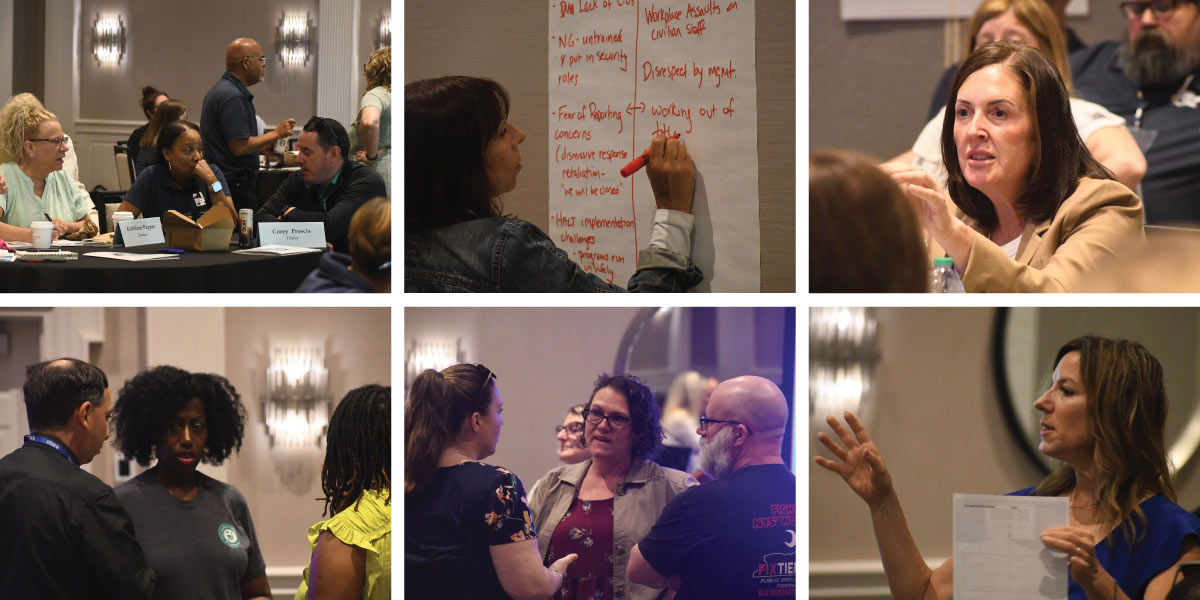
A June 12 meeting spearheaded by PEF’s Health and Safety and Training and Education departments sought to find solutions to some of the major concerns highlighted over the years.
The meeting focused on several ways to combat issues in the workplace and effect change moving forward. Members were encouraged to identify their specific workplace concerns, jumpstart activity in their local health and safety committees, and practice exercising the right to refuse hazardous work, which is protected under the New York State Public Employee Safety and Health (PESH Act.
PEF believes those steps can help mitigate some DOCCS workplace issues; however, PEF agrees with members who feel that the root of most safety concerns lies with the HALT Act passed in 2022, which limits how incarcerated individuals are disciplined.
Last year, thanks in part to PEF’s advocacy against the HALT Act, a Task Force was formed to find new recommendations for reforming the act with employee safety in mind.
At the meeting, members watched a video released by DOCCS showing the assault of a PEF member at the Lakeview Shock Correctional Facility in Brocton, N.Y., earlier this year. The member, an offender rehabilitation coordinator, was violently assaulted by an incarcerated individual while she was instructing a class with the individual and others. Officers were able to respond and subdue the attacker, but only after the member suffered several injuries. Members say HALT is why assaults are on the rise.
Indeed, data compiled by PEF from DOCCS reports that track violent incidents inside facilities show incidents increased by 45% over the past two years. Mid-State, Marcy, and Five Points Correctional Facilities saw the greatest increase, with Mid-State nearly doubling their incident rate from 68 in 2024 to 131 in 2025.
PEF Statewide Health and Safety Co-Chair Leisa Abraham said that while these numbers are a troubling trend and clearly show HALT is not working as intended, it’s still critical for members to document every incident to ensure that data can be brought to conversations with DOCCS, management, and other high-level decisions makers.
“We need the information so we can go back to DOCCS and legislators and the advocates so that they understand that we’re trying to keep not only our staff safe, but the incarcerated individuals as well,” said Abraham. “Without documentation, we cannot show where the issues are and it all becomes anecdotal.”
Gabriela Franklyn is the other co-chair for the Article 18 PEF Health and Safety Committee. She agreed with Abraham that reliable data is key.
“We have to start accurately reporting in real time, immediately advocating in real time and using our resources from a union perspective, then escalating that to engage legislators,” said Franklyn. “We need to be effective communicators, expose what is going on, and hold people—including ourselves—accountable for addressing policies that are not appropriately addressing functions and operations in our facilities.”
PEF Legislative Director Pat Lyons said that PEF and other unions have worked hard to bring the task force recommendations to legislators, but support from the members will make a big difference.
“A lot of our roadblocks are the Governor, the Commissioner, and the culture at DOCCS, as well as other outside forces. These are things we can change if we have you and people working with you supporting us,” said Lyons. “I encourage you to get involved with PEF’s Political Action Committee, send letters to your legislators, and encourage others to do the same. By building conversation and momentum, we can make change a reality.”
For both co-chairs of the health and safety committee, the paths of approach to effect change outlined at the meeting give them hope that members will go back to their facilities confident that the union is behind them.
“I hope that leaders will feel confident talking with both their members and management about their needs as far as workplace health and safety is concerned,” said Abraham. “I am hoping that they can get their members motivated to become much more involved in their own health and safety and less apprehensive to provide the information and documentation that we all need to effect change.”