

July 8, 2026 — PEF President Wayne Spence held a Telephone Town Hall on June 23 to discuss the latest PEF tentative agreement with New York State that covers most members of the union – specifically, those who are part of the Professional, Scientific, and Technical bargaining unit, or PS&T. Joining President Spence on the call were the union’s Chief Negotiatior Mark Richard, PEF Vice President and Contract Chair Darlene Williams, PEF Contract Administration Director Ben Traslaviña and PEF Executive Director Deb Greenberg.
The call began with a summary of the gains in the Contract. The five-year deal, if ratified, provides PEF members with across-the-board salary increases of 4.5% in the first year (retroactive to April 2026), 4% in the second year, 3.5% in the third year, and 3% in the final two years. Additionally, the $600 annual Higher Education Differential—which sunset when the last contract expired—will be paid to eligible members each year of the agreement.
Other economic gains include increases to Geographic Adjustments (location pay) for members who work Downstate and in Mid-Hudson Valley locations. Ulster County was included for the first time in the Mid-Hudson Adjustment.
“I want to note that this is one of the things that we pushed for at the end that distinguishes our Contract from all the other contracts,” said Traslaviña on the call.
Additionally, a Hazard Duty Bonus of $300 will be paid to members who work at OPWDD, OMH, OCFS and DOCCS facilities that house individuals who are in the care or custody of the state. This bonus is in addition to hazard duty pay.
Traslaviña also detailed improvements to PEF’s dental plan. PEF has sought to self-administer a dental plan for more than a decade, ever since President Spence was first elected in 2015. For years the Governor’s negotiating team wouldn’t even consider it, but after the rally outside the State Capitol on June 4 and late-night talks between President Spence and Governor Kathy Hochul, it was written into the Contract that PEF has the right to establish an Employee Benefit Fund to administer dental and vision benefits, similar to what other unions like CSEA and UUP have done for years.
“We estimate that the value above what the state is currently paying for dental benefits is approximately $40 million a year,” said Traslaviña. “We aim to improve dental benefits and make them on par or better than the other state union benefit funds.”
Assuming the Contract is ratified, PEF will begin establishing the Benefit Fund immediately, but it will take some time and in the interim the Contract includes several improvements to the current dental plan. These improvements are a $1,000 increase in the maximum annual benefit and orthodontic benefits. Both benefit maximums would be set at $4,000 per year. Additionally, the benefit for dental implants was doubled to $1,200, and two routine exams and cleanings per person will be covered in network and not count against the maximum annual benefit.
Other gains include increases to Special Assignment Duty pay — a benefit that many DOT members who work on highways receive — and a new prenatal leave benefit that permits employees seeking fertility treatment or prenatal care to use up to 20 hours of leave without charging accruals. Moreover, the new Contract will eliminate stacked copays in many instances, so that members will no longer need to pay multiple co-pays for a single visit to the doctor.
As with all contracts, gains also come with some tradeoffs.
The value of sick leave in retirement will change in the new Contract. The current actuarial table used in the previous contract valued sick leave in retirement according to a life expectancy table that was created in 1999. The state will now use an actuarial table from 2015, which shows increased life expectancy and thus will slightly reduce the value of sick leave credits when applied to health insurance premiums in retirement.
((INSERT LINK TO MARCI VIDEO))
“But you should take into account that your sick days are going to be more valuable by virtue of the across-the-board increases. It is pegged to your salary,” said Traslaviña. “You are making more money, so your sick days are worth more.”
The state also pushed to eliminate acupuncture and massage therapy coverage in NYSHIP. PEF pushed back, and the agreement reduces the amount of out-of-network acupuncture visits to 15 with a $125 cap per visit. In-network, medically necessary visits remain unlimited. Massage therapy has no network and was reduced to 15 annual visits with a $125 cap per visit.
Hyperinflated drugs were also subject to negotiations. These are drugs that tend to increase in cost dramatically over time without a corresponding medical justification for the increase. This does not include GLP-1s like Ozempic and Wegovy.
“The state did come after GLP-1s,” said President Spence on the Town Hall. We stopped that. It is not a part of it. The state wanted to take it away and not cover it, but that did not happen.”
The final list of hyperinflated drugs has not yet been assembled by PEF or the State. Members who have prescriptions to what are determined to be hyperinflated drugs will receive 45-days notice of any change in coverage.
“You’ll then have an opportunity to bring that to our attention,” said Traslaviña. “If you still need that drug for whatever medically necessary reason, my office can work with you to push back and accommodate your situation. We will fight to ensure that you get the medical care you need.”
Lastly, the State reduced the reimbursement amount paid to out-of-network providers. PEF believes that in the long-term the move will reduce overall costs to NYSHIP and will motivate out-of-network providers to come in-network to receive more compensation.
“We anticipate it will help reduce premium cost increases,” said Traslaviña.
Longevity Pay, Performance Advances and the Productivity Enhancement Program all remain the same.
Chief Negotiator Mark Richard then took a moment to praise the tactics and member-driven focus of PEF President Spence and the negotiating team. This is the fifth contract they have negotiated together. He made clear what a yes vote in favor the contract means: Retroactive payments and more money in the pockets of members. Richard said that the team’s insistence on fighting for better dental, across-the-board raises, and a guarantee from the State to release results of the Total Compensation Study conducted by the NYS Department of Civil Service by the end of January 2027 are big gains for the union. He also said that a no vote from the membership would restart negotiations back at square one.
“A no vote is a no vote. We return to the table,” said Richard. “New negotiations could be quick, or they could literally go on for years. All these things could lead to a better contract, but they could also lead to economic changes.”
Richard noted that federal SNAP and Medicaid payments are on the chopping block for New York State. In addition to a potentially strained State budget, the federal budget and inflation could make negotiating a new contract more difficult.
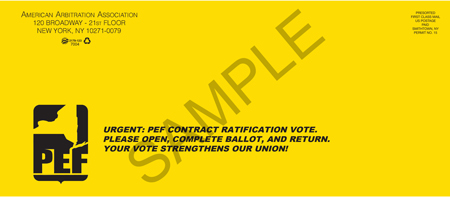
As the Town Hall wrapped up, Vice President Williams and Executive Director Greenberg shared next steps. Ballots will be mailed in a bright yellow envelope from the American Arbitration Association (AAA) on July 8. Members will also receive a paper copy of the tentative agreement as a Special Communicator Edition in the mail around the same time as the ballots. Only PEF members who were dues-paying members as of June 17, 2026, are eligible to vote.
Once members have marked their ballots, they need to mail it back to AAA by July 30 in the postage-paid envelope. Ballots must be RECEIVED by AAA by 5 p.m. on July 30, so it’s paramount that members mark their ballots and return them quickly.
President Spence closed out the Town Hall by saying that PEF members do not accept cookie cutter contracts. He praised the Long Island Rail Road for getting a 4.5% raise in their contract and helping set the pattern for other unions. He recognized that breaking patterns is difficult, but that new money in dental and the promise of the compensation study results move PEF forward. He urged PEF members to cast an informed vote.
“Educate yourselves, but most importantly vote,” said President Spence. “If you vote it up, vote it up in large numbers because politicians will look and say: ‘Hey, only 20% of PEF members voted on their contract? Why should I take them seriously?’ I am telling you to come out and vote.”