August 7, 2026 — At a special meeting June 11, the Executive Board voted to approve the full text of the 2026-2031 PEF/State Tentative Agreement and send it to the membership for ratification.
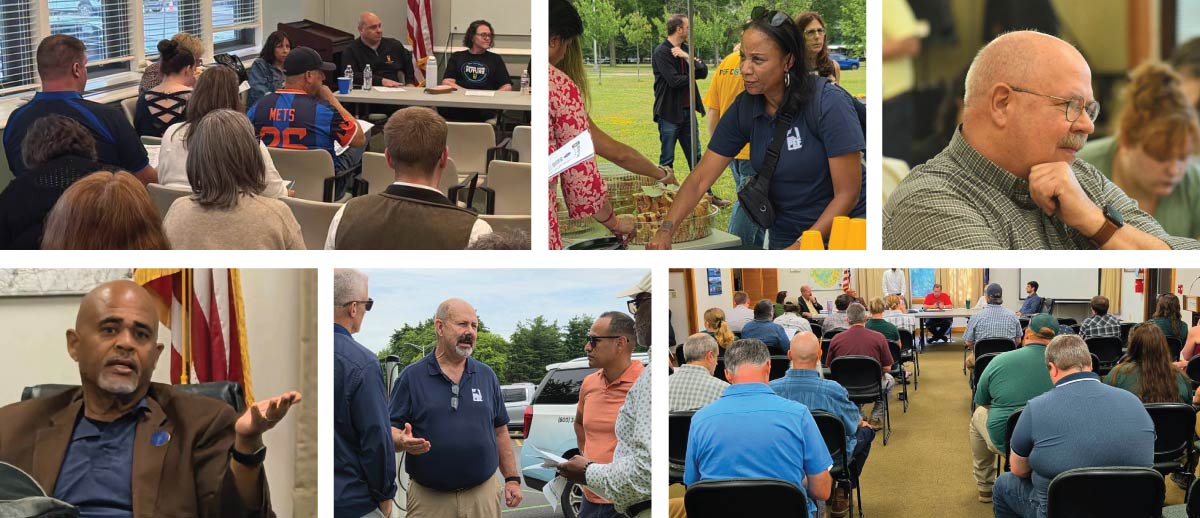
PEF President Wayne Spence then led his fellow Statewide Officers and the Contract Team on a statewide tour to meet with members, discuss details of the agreement, and field questions about the agreement’s across-the-board wage increases, a new dental benefit, changes in copay structure, and much more.
From mid-June to the Fourth of July, PEF held 44 meetings in Regions 1, 2, 3, 4, 5, 7, and 8, with more than 1,000 members attending. More stops are scheduled for the rest of this month in the Regions that have not yet been visited. (RSVP here to attend a meeting.)
PEF Contract Chair and Vice President Darlene Williams said the team was the first union at the table and worked tirelessly to get a contract with across-the-board wage increases that mattered to members.
“When we introduced our proposals at the table, we started with Article 7,” she said. “We opened a four-year contract with across-the-board wage increases of 6%, 6%, 5%, and 5%. The state, after many months of not coming to the table with a counteroffer, came back to the table with a three-year contract with increases of 3% each year. We said no.”
When other unions accepted a tentative agreement that delivered 4.5%, 4%, 3.5%, 3% and 3% raises over the course of five years, President Spence instructed the team to hold out for a better deal.
That perseverance, coupled with PEF’s commitment to bringing a fair contract to members that recognized their skills as professional, scientific, and technical employees, led to multiple actions that pushed the state to add $40 million in seed money for a new dental and vision plan that would be administered by PEF, a guarantee that the state would release the results of the total compensation study commissioned by the state and discuss it with the union, additional upgrades to health insurance, and more.
“The Albany rally drew more than 500 people and helped us send a message to the Governor that we would not just accept what other unions were getting,” said Vice President Williams, about the June 4 rally outside the State Capitol during a meeting of the Executive Board. “The dental plan and the compensation study have been PEF priorities for some time. Now we have that built into this contract for our members.”
At a meeting at the Hornell State Office building in Region 2 and several meetings in Region 7, members had questions about the new Employee Benefit Fund. Team members said the vision is to establish an in-house, PEF-administered plan similar to or better than the plan offered by CSEA. While it would take some time to setup, members would not see a gap in coverage while PEF works to get the plan up and running.
Director of Contract Administration Ben Traslaviña said it may take about a year for the benefit fund to be ready for members, but in the meantime, the tentative agreement puts in place increases to current benefits that will bridge the gap.
“PEF has negotiated increases to the current dental plan, including $4,000 for your annual maximum, $4,000 for the lifetime orthodontic maximum, and up to $1,200 for implant coverage per implant,” he told members at a contract meeting. “Crowns and inlays can now be replaced every five years instead of every three, and the out-of-network reimbursement schedule is increased by 10%. For those paying out-of-network costs, those will now be decreased.”
At several meetings, including the Region 7 meetings at OPWDD’s Sunmount facility and Adirondack Park Agency, members reacted positively to elimination of stacked copays in health insurance, something that commonly happens with lab work, as well as the compounding nature of across-the-board wages.
Using a Grade 18 as an example, team members drove home the value of the tentative agreement.
“Not including step increases, a Grade 18 member whose salary is currently $88,000 will see their salary increase to $91,960 in the first year of the contract,” said contract team member Chris Ford at a meeting in Ogdensburg.“They will break six figures at $105,014 by the end of the five-year agreement.”
Many were concerned about the duration of the agreement. The most common question at each meeting was why PEF agreed to a five-year deal and how PEF arrived at a 4.5% starting increase, as well as why the wage increases—through compounding—decrease over time.
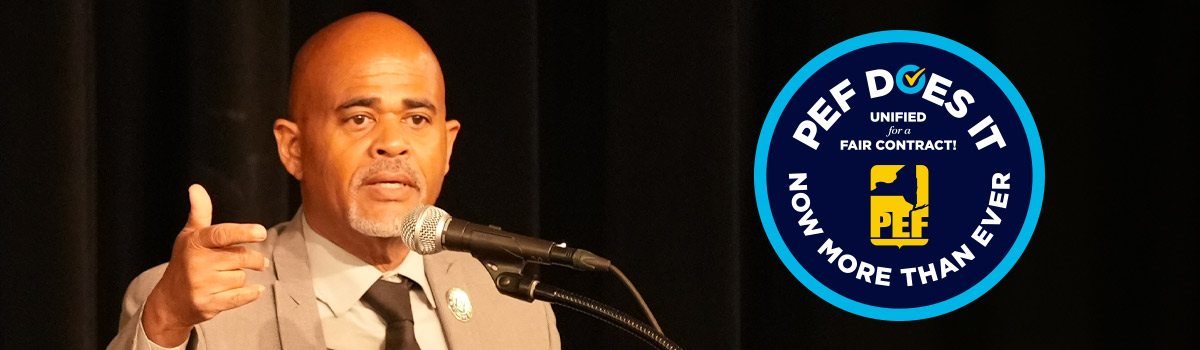
“When other unions are given a contract and they agree to it, even tentatively, it sets the pattern for all the other unions,” President Spence told members at several meetings. “The Governor is negotiating with PEF, CSEA, NYSCOPBA, the State Trooper’s Union and UUP all at the same time.”
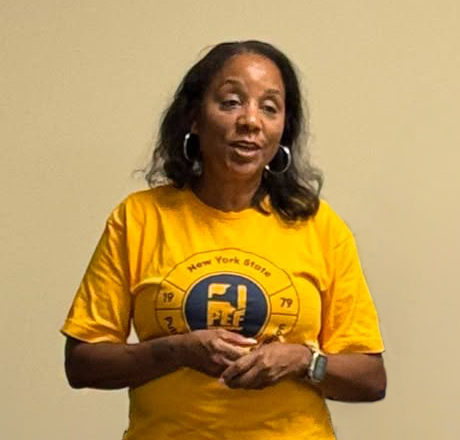
VP Williams said that was why PEF fought to add more, like the dental plan and the release of the Civil Service study, to set PEF apart from other unions.
Many members said information provided at the meetings eased their concerns about the length of the agreement.
Beth Murray, a Registered Nurse with OPWDD in the Finger Lakes, said that while she was a hard sell on a five-year contract, ultimately, the benefits outweighed the risks.
“I am not a huge fan of the five years, but the contract doesn’t offer us anything that is terribly negative,” said Murray. “Plus, I am a huge fan of the raises and the cumulative amount of money it puts back in our pockets.”
William Mack, a Registered Nurse at OMH agrees. As he looks ahead to the potential future, he said the security the wage increases provide is worth it.
“The likelihood of us having a financial crisis or crash in the next five years seems more likely than having a lengthy protracted inflation, and having gone through all those years with 0-2% raises, I am happy to lock in for five years,” he said.
All members are encouraged to return their ballot – regardless of their vote – because it sends a message to the Governor and to legislators that PEF members are engaged and powerful.
“This team worked hard to preserve the rights and the value of PEF members because we are professional, scientific, and technical employees and that sets us apart,” said Vice President Bruce Giddings. “My initial thought was that five years was a little concerning. However, after researching, after discussing with the contract team, after considering everything, I’ve reconsidered my thoughts. I firmly believe that this five-year contract is a positive contract.”
Members still have a chance to hear from the Contract Team at upcoming meetings in Regions 6 and 9-12 through July 13. Members who are interested in attending a meeting should RSVP.