

Editors Note: We are reprinting Jim’s story with permission from AFT.
Statewide Retirees President Jim Carr was recently featured in AFT Voices, a publication created by the American Federation of Teachers (AFT) that highlights the real-life experiences of over 1.8 million union members, including teachers, nurses, and public employees, through personal stories, challenges, and policy views.
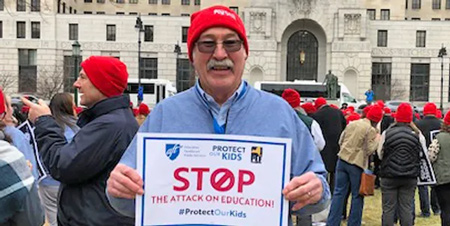 August 6, 2026 — I graduated from college with no clear path into my field, and like many new graduates, I took whatever work I could find. My first year out, that meant substitute teaching and refereeing wrestling matches.
A turning point came when I was able to do student teaching in health and physical education with a friend, John Leske, at my old high school. That experience eventually opened a door I didn’t expect. In summer 1974, John called me about a job he had at Elmira (N.Y.) Correctional Facility teaching health three nights a week. He was overloaded and asked if I wanted to step in. I said yes, and the decision became the foundation of my entire career.
That first role was part time, but it gave me something I didn’t have before: a foot in the system. I learned the job, figured out the expectations, and eventually made it onto the civil service list. From there, I moved from temporary to provisional to permanent employment.
I was hired as a physical education teacher and eventually ran recreation programs for incarcerated individuals. The scope of that work was broad — organized sports, boxing, powerlifting, basketball, softball, soccer and intramural leagues. It wasn’t just about activity; it was about structure, routine and engagement.
When I started in 1974, I wasn’t part of a union yet. Once I moved into full-time employment, I joined the pension system and became part of the state workforce represented at the time by the Civil Service Employees Association.
At that point, the American Federation of State, County and Municipal Employees, Council 82, represented correction officers, and later the professional, scientific and technical workforce would form the New York State Public Employees Federation, an affiliate of the AFT. The labor landscape was shifting, and I was entering it right as it was taking shape.
The 1979 prison guards’ strike
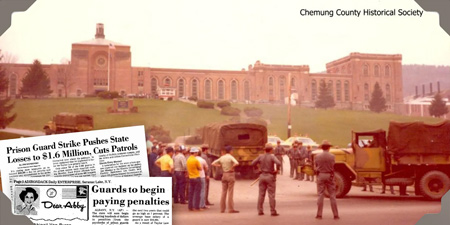 One of the defining moments of that era was the 1979 correctional officers’ strike under New York Gov. Hugh Carey. The strike ran from April 18 to May 5 and became one of the largest prison employee strikes in U.S. history.
It was rooted in long-standing frustrations: staffing shortages, declining contract gains, and deteriorating working conditions. The state responded by activating the New York National Guard and bringing in state police to maintain prison operations.
Because public employee strikes were illegal under New York’s Taylor Law, participants faced severe penalties, including loss of pay. Even so, the system impact was enormous — facilities were disrupted, leadership was under pressure, and non-striking staff were placed in difficult positions.
At Elmira Correctional Facility, many civilian employees, including myself, were not part of the strike but refused to cross the picket line. After the strike, penalties were applied broadly, including to people who had not participated but did not cross the picket line. That’s where my first real experience with union activism began.
At the time, PEF was still in its early formation. We approached the union and asked to pursue an Article 78 legal challenge but were told it likely wouldn’t succeed. When leadership declined to move forward, we decided to act independently.
A group of us pooled our own money — about $250 each — and hired an attorney. We formed what we called a non-uniform employees legal fund and filed affidavits in July 1979. The case, Betzler v. Carey, challenged the withholding of pay under the Taylor Law framework.
The process took years. In January 1983, the court ultimately ruled in our favor. Initially, there was partial relief, but the final outcome required full restitution of withheld penalties. It became a precedent-setting decision.
Eventually, even union members who had not participated in the lawsuit were reimbursed. The action helped establish that collective pushback — formal or informal — could shape outcomes for workers.
Life during and after the strike
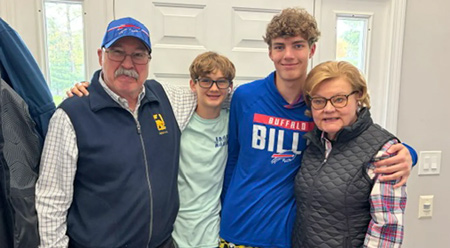 The personal impact of that period was significant. I had a 1-year-old, a newly purchased home, and a wife who was also working as a teacher in Elmira. When the strike unfolded, we applied for food stamps just to get through the 16 days without pay or benefits.
At the same time, there was real tension in the workplace afterward — between those who crossed the picket line and those who did not, and between staff and the broader correctional system that had been temporarily staffed by outside forces.
In the ’70s, the Attica (N.Y.) Prison riot had already reshaped correctional policy and staffing. In its aftermath, reforms led to hiring more civilian professionals — teachers, counselors and program staff — which is how I ended up in the system in the first place.
But many of the underlying issues — staffing shortages, facility classification changes and safety concerns — never fully went away. Over time, facilities like Elmira were reclassified from medium to maximum security without meaningful physical changes, only administrative ones.
Looking back
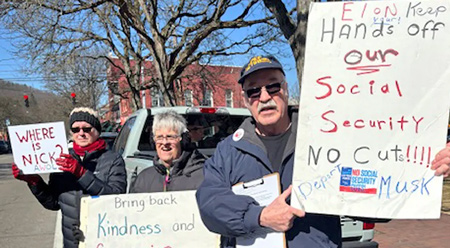 Over time, I became more involved in union work, serving as a steward, council leader, regional coordinator. After retiring in 2006 with 33 years of service, I continued in leadership roles, including statewide responsibilities.
The union work itself evolved with me. My focus became understanding contracts, representing members effectively, and using grievance and labor-management processes to hold the system accountable. The job wasn’t just administrative; it was also advocacy based on real-life experience.
Being a leader in PEF also helped me remember something I learned early on: Solidarity is important. People often made gains by organizing themselves first, whether it was through formal unions or more informal forms of collective action.
The strike years, the legal fight and the early organizing work didn’t happen in a vacuum; they changed how I thought about work, duty and collective action.
I learned early on that circumstances don’t change on their own. People change them — sometimes through unions, sometimes through courts, and sometimes by refusing to accept outcomes that don’t make sense.
Editors Note: We are reprinting Jim’s story with permission from AFT.