
September 28, 2026 — For 25 years since the tragic events of Sept. 11, 2001, PEF staff and members have taken the time to honor those killed in the attacks. Of the nearly 3,000 lives lost that day were 34 PEF members who worked at the Department of Taxation and Finance and three members from the Department of Transportation.
Immediate Response
Americans across the country and PEF members across New York State mobilized immediately to help one another, save lives, and eventually help each other grieve.
After the North Tower was hit at 8:46 a.m., it took only 17 minutes for the South Tower to suffer the same fate at 9:03 a.m. Already aware of the attacks, PEF joined in talks with other unions and then-New York Gov. George Pataki.
“There are at least three State agencies, DOT, Tax & Finance, Office of the State Comptroller and NDRI that have work locations in the two tower buildings of the World Trade Center,” reported then-PEF President Roger E. Benson in a memo to all members. “At this time, we have very limited information regarding the fate of these approximately 300 PEF members but have very serious concerns regarding DOT and Tax & Finance which were all located on the 82nd – 87th floors of the two buildings.”
All State offices in New York City and downtown Albany were closed immediately, and by 2 p.m. on Sept. 11, 2001, Gov. Pataki sent all “non-essential” personnel home.
By 4 p.m., PEF informed its members that the State would reopen all offices and facilities the following day, and PEF members were encouraged to donate blood at local Red Cross centers.
“The need for blood transfusions in New York City has already exhausted the existing supply and they will be depending on the rest of New York to make up the shortfall. We strongly encourage anyone who can donate to contact their local Red Cross immediately,” said President Benson.
In the days, weeks and months following the attacks, it took time for PEF, New York City, the State, the country and the world to pick up the pieces.
The New York City PEF office, though intact, lost power for several days. At the time, PEF could not account for up to 50 members from DOT and Tax and Finance. It wasn’t until September 18, that PEF finally narrowed down the number of PEF members that would eventually be counted among the dead.
By September 19, PEF was in contact with AFT and SEIU—PEF’s international unions—to work with the U.S. Department of Labor to ensure that Worker’s Compensation claims were not exempt due to an “act of war.” The PEF Executive Board voted to send $5,000 to the families of missing PEF members and approved a resolution condemning acts of discrimination, violence or retaliation against Middle Eastern-Americans and those who practice Islam.
One Month Later
By October 2001, President Benson mobilized members to create the PEF World Trade Center Relief Fund, which took in donations from around the country, as far away as Alaska. In December 2001, the union reported raising up to $80,000 for families in need. PEF also coordinated the creation of several memorials, including one at the Harriman State Office Campus in Albany, and at the 23rd Annual PEF Convention held that year in Niagara Falls. PEF continued to advocate for members, and their families to receive as much aid as possible as they learned to live with a new reality.
Insurance offered through the union and through the PEF Membership Benefits Program offered a $50,000 benefit for members killed on the job and a $15,000 accidental death benefit. An additional $10,000 benefit was offered through PEF MBP’s Assault, Trauma and Captivity insurance, which is offered free to all dues-paying PEF members.
PEF also advocated to strengthen emergency response plans at various agencies. At the time, agency preparedness plans were inadequate or outdated, but in the wake of the attack and the sudden threat of anthrax in the years following the attack, PEF pushed hard for improved health and safety plans.
“There is a heightened awareness of the need for improved emergency response and evacuation procedures,” said then-PEF Director of Occupational Safety and Health Jonathan Rosen.
Health and safety committees throughout the state also began training to deal with future threats, including potential bioterrorism.
One Year Later
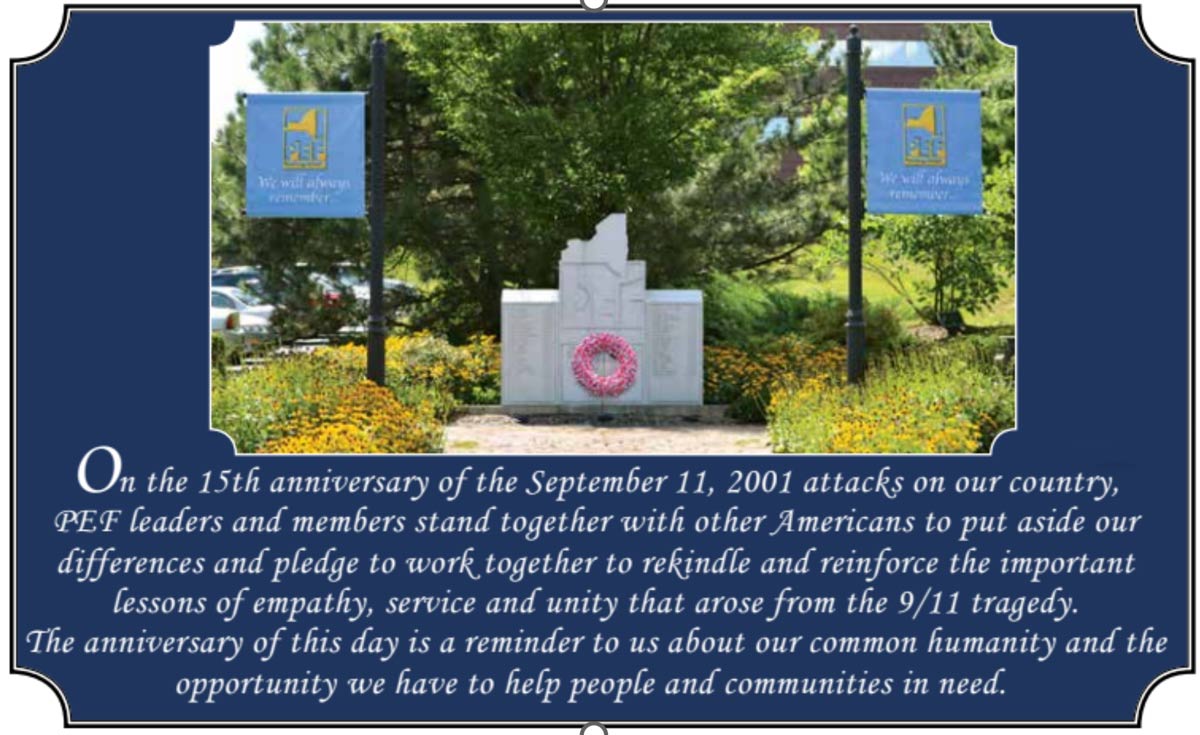
On Sept. 11, 2002, PEF held a special ceremony to dedicate a new memorial and garden at PEF Headquarters in Albany. The memorial holds the names of all 34 members who lost their lives the day of the attack, as well as other members who have been killed on the job during PEF’s history.
“As we dedicate this striking monument today, if there is one thing we can do to honor the memory of these brave workers, it is to express our solidarity with them,” President Benson said. “We will not forget, and we will not permit our elected leaders to forget our members who made the ultimate sacrifice in the service of New York State. We are here today to pay tribute not only to the individuals, but also to the important services they delivered.”
Nearly 100 members of PEF Division 233 formed Pilgrim’s World Trade Center Disaster Response Team, providing counseling and grief groups to help New Yorkers and other PEF members deal with the pain of loss.
By 2002, the PEF World Trade Center Fund drew upward of 480 contributors from across the country and raised more than $100,000.
Around this time, health hazards from those who were near the World Trade Center at the time of the attacks, including those who were involved in rescue and recovery efforts, became more apparent. PEF advocated that the state and the federal government assist those who were impacted by dust, debris, or other hazardous fallouts from the attacks.
“This was an unprecedented event that posed unique health hazards for our members and other state employees. We need to continue monitoring the health of these employees for an extended time to identify negative health effects and effective treatments,” Rosen said.
Five Years Later
With most funding and relief now in the hands of members who needed it, PEF continued to mourn those who passed and to fight for the living. At a 2006 memorial event, then-PEF President Kenneth Brynien and Secretary-Treasurer Arlea Igoe placed a wreath at the memorial site at PEF Headquarters.
Building on President Benson’s call for PEF members to stand united and to keep fighting for one another, Brynien said that the most important thing the union could do to honor the PEF members who were killed was to continue to stand together.
“We must continue building on the unity forged in the fires of September 11,” said President Brynien. “Working together to improve the lives of our members, whether through our political action, contract fightback or mobilization efforts is the best tribute we can make to our colleagues in recognition of the sacrifice they made.”
PEF spent years advocating for updates to New York’s health and safety laws and expanding World Trade Center benefits. In 2006, a new state law took effect that extended the deadline to file for Workers’ Compensation claims related to the attack and expanded it to include workers and volunteers who participated in rescue, recovery or clean-up work, especially in the case of exposure to toxic chemicals.
Almost 10 Years Later
Though time is supposed to heal wounds, by 2010, the union’s 9/11 wounds were reopened. In December 2010, Jerry Borg, a PEF member who worked for the Department of Taxation and Finance, passed away due to complications caused by a lung condition from inhaling dust near the attack.
Borg was doing an audit at a nearby building on the day of the attack and was caught in a cloud of dust following the collapse of the buildings. At the time of his death he was one of only three who passed due to health complications.
With his passing, the count of PEF members killed as a result of the attacks rose to 35. Borg was added to the PEF memorial outside headquarters.
“The terrible events of September 11 continue to haunt us,” Brynien said. “It was also a time that brought out the best in our members. They responded to the attacks with courage and a sense of responsibility. Our members helped in the rescue and ensured the vital services provided to New York citizens were not interrupted.”
15 Years Later and beyond
Each year, PEF continues the tradition of honoring those killed by reading their names aloud on the anniversary of their deaths and invites members and PEF staff to the memorial to talk about the lives lost, the bonds strengthened, and the lessons learned.
PEF continues to advocate for better health and safety protocols and celebrates and recognizes the unity displayed by so many PEF members, New Yorkers and Americans following the attack.
“As a parole officer, we are called to run to danger and I know a lot of first responders passed away during 9/11,” PEF President Wayne Spence said at the 2021 anniversary ceremony. “Thirty-four PEF members, state workers, went to work 20 years ago and didn’t come home. In the aftermath there was a comradery in the United States. It wasn’t for a day or a week; it went on for months, almost a year. I remember seeing people driving around with stickers of flags on the back of their cars.”
At the 23-year anniversary ceremony at PEF Headquarters in 2024, former PEF Executive Director Todd Kerner, who worked for Taxation and Finance and was in New York City on September 11, 2001, recalled how normal the day seemed, and how much the sacrifice of the members meant to him.
“People just wanted to do their jobs,” he said. “I hope we continue to remember their sacrifice.”