

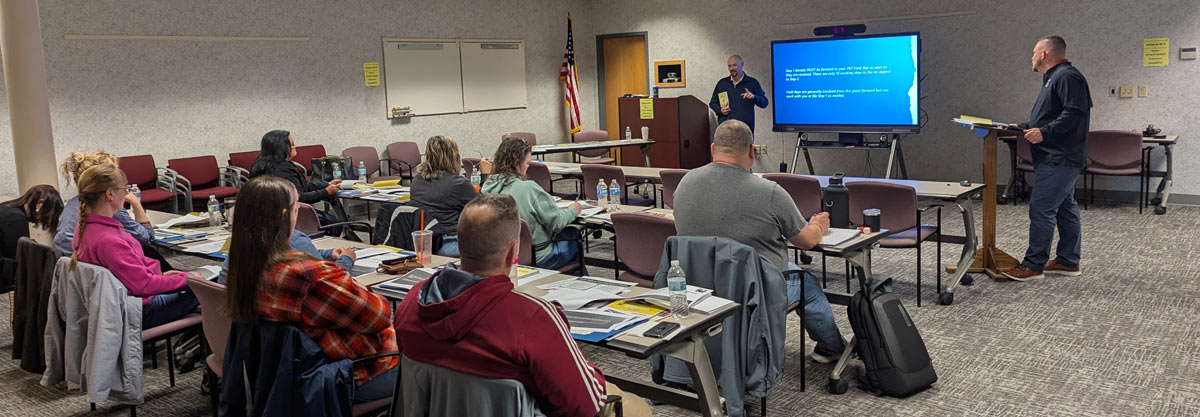
December 12, 2025 — PEF offers steward training across all 12 of the union’s regions. Each region has different training techniques and the sessions often vary based on the instructors. So when Debbie Egel started working as the Interim Organizer of Field Services for Regions 10-12, she wanted to do something to shake things up.
“I think a lot of members felt there was a lack of engagement with the material,” said Egel. “The lectures were good, and the information was great, but members were not keeping up with the material. Some people were taking phone calls and checking texts. We needed a change.”
Egel paired up with PEF Senior Field Representative Bradley Kolb to design a new Steward Training focused on boosting engagement and interactivity. They believed that since PEF represents thousands of professional, scientific, and technical titles, training should be better tailored to suit specific regional needs.
“I think the main issue here is one shoe does not fit all,” said Kolb. “PEF represents over 3,000 titles in more than 70 different agencies. Each agency has different internal policies, memorandums of agreement, and other mechanisms. We wanted to resolve this issue by targeting specific groups of members and creating the training, so everything contained is applicable to the members in the classroom.”
Egel agreed, citing that while PEF staff are typically familiar with the general practices involved with being a steward, representing the members, and problem solving, when issues arise on site, a steward is the first line of defense.
“Engagement was part of the issue, but what we wanted to make sure new stewards understood is that they are the live embodiment of the contract and of the union,” said Egel. “Stewards are on the ground and know what the issues are at their agencies better than we do. We want to make sure they’re equipped to handle those issues and that they know their rights and the contract.”
Egel and Kolb began by going through the existing training modules that exist across each region. From there, they combined useful information from the modules and identified what was missing. The result was a mixture of lecture-based learning and interactive exercises to make the training fun and engaging but also memorable.
“It was important that we made sure that members receive and retain the training,” said Kolb.
In November, Egel and Kolb were ready to launch their newly designed training. The training included exercises that went over contract language, effective communication, as well as spotting issues and filing grievances. It also included a Jeopardy style game that quizzed members on labor-management, standby vs. on-call and several key parts of the PEF contract. The focus, said Egel, was on making sure the training was interactive and expanded their basic knowledge.
“We tried to give people not only the communication skills they needed to be able to talk about the contract, but also we tried to make sure they could articulate the difference between Must, Shall, May and Could where it appears in the contract,” said Egel. “Some of the participants did not realize how important the language is right down to those specific words.”
PEF Vice President Darlene Williams was at the training in November. She felt that Egel and Kolb’s goal to boost engagement was not only achieved, but it also helped to build confidence in the participants.
“If we truly want members to understand how the grievance process works, then walking them through writing a first-step grievance and showing them how it gets submitted is essential,” said Vice President Williams. “This training helped members understand whether their grievances are viable, what steps they should take before filing, and when a first step is or is not appropriate. It sparked important conversations among the participants about what should happen first and where to go next.”
Williams believes that November’s training is a strong foundation for PEF to build on and refine in order to create a complete package that new and existing stewards can refer to and use on the job. She also believes a stronger first-step grievance writing section would be a benefit to participants and, with proper samples brought back from the training, a benefit to members at their worksites.
“Overall, the training was excellent. The activities, examples, movement and interaction the presenters used kept the room energized,” said Williams. “The real sign of success was when participants returned from a very nice lunch still eager to learn, still participating, and still fully committed.”
Feedback following the training backs up Williams’ review. Out of about 20 Stewards, 19 strongly approved of the training in exit surveys. Many cited that they wanted more coverage of the contract and a deeper understanding of Articles. Others felt that they walked away with an understanding of what it means to be a PEF Steward.
Kolb was happy to receive the feedback and has already begun refining the training. He thinks that PEF staff should receive the training as well.
“I think staff would have greater insight and input into the training,” said Kolb. “It would help us expand the training to other regions and update the trainings for the new PEF leaders we’ve had over the past few years.”
Egel hopes that this is a great start for members to get involved further and looks forward to hearing from the new Stewards as they put the training to good use at their agencies.
“I was so impressed with everyone’s engagement, responses and thoughtfulness that I told them I could not wait to see the first grievances they write,” said Egel. “I think this training was very helpful for members. If the foundation of the union is the contract and we’re not clear on what is in it or what it means, then Stewards have a harder time interpreting the articles. Training like this can really help change that.”