
This article was excerpted with permission from Why Fascists Fear Teachers: Public Education and the Future of Democracy, published by Thesis, an imprint of Penguin Publishing Group, a division of Penguin Random House LLC. © 2025 by Rhonda Weingarten.
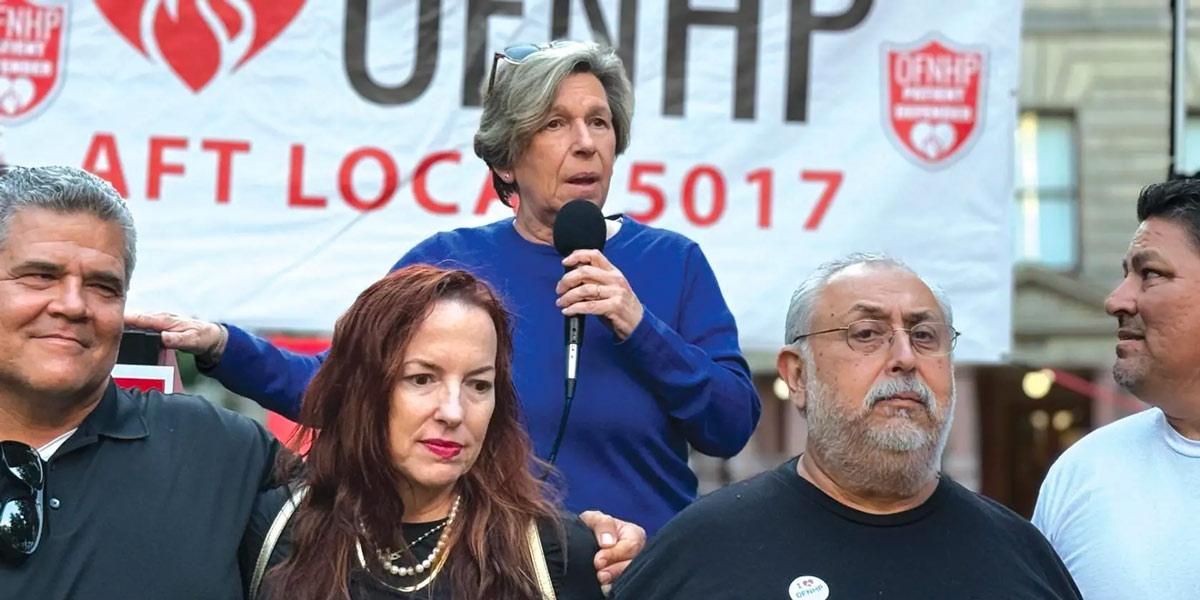
As President Joe Biden often points out, “The middle class built America, and unions built the middle class.”1 It is incredibly powerful to look at historic charts of union membership versus income distribution in the United States.2 When unionization rates rise like a mountain, income inequality craters into a valley. Unions level the playing field. But, of course, the opposite is also true. When unionization declines, income inequality rises.
The earliest forms of labor organizing in America were enslaved Black people and enslaved Native Americans leading rebellions throughout the 18th and 19th centuries.3 In 1794, the first known union in the United States—a union of shoemakers—was founded in Philadelphia.4 Mill workers in Lowell, Massachusetts—including girls as young as 12—formed the first union of working women in the nation and in 1834 went on strike over wage cuts.5 In 1867, around 3,000 Chinese laborers building the Transcontinental Railroad launched what was at the time the largest strike in the nation’s history, stopping work to demand better wages.6
In the mid-1800s, Americans regularly worked 12 hours a day or even longer.7 Between 1890 and 1910, almost one out of every five children between the ages of 10 and 15 was working.8 And conditions were abysmal. As just one example, the nation was rocked in March 1911 when the Triangle Shirtwaist Factory in lower Manhattan caught fire.9 Poor ventilation meant the fire spread quickly, and locked doors and a single faulty fire escape meant workers couldn’t get out. That day, 146 burned alive or leapt from windows to their death.
But it was only because unions pressed for change that, in 1938, the federal government passed the Fair Labor Standards Act.10 The law established a maximum workweek of 40 hours and required that anyone working more than that be paid overtime. Plus, the law established a federal minimum wage and banned child labor. It would take over 30 more years for unions to win the Occupational Safety and Health Act in 1970, creating minimum workplace safety and health standards.11
As the power and influence of unions grew, so did attacks from employers. It became common for businesses to “spy on, interrogate, discipline, discharge, and blacklist union members.”12 So unions also pressed for and won the National Labor Relations Act. Enacted in 1935, the law guarantees workers “the right to self-organization, to form, join, or assist labor organizations, to bargain collectively through representatives of their own choosing, and to engage in other concerted activities for the purpose of collective bargaining or other mutual aid or protection.”13 This is the foundation of labor rights—giving real voice and workplace democracy to millions of American workers who had for too long been powerless.
Why do fascists, oligarchs, autocrats, and the far right hate unions so much? To understand that, it’s important to first understand how unions work.
Unions Give Workers a Voice—and Power
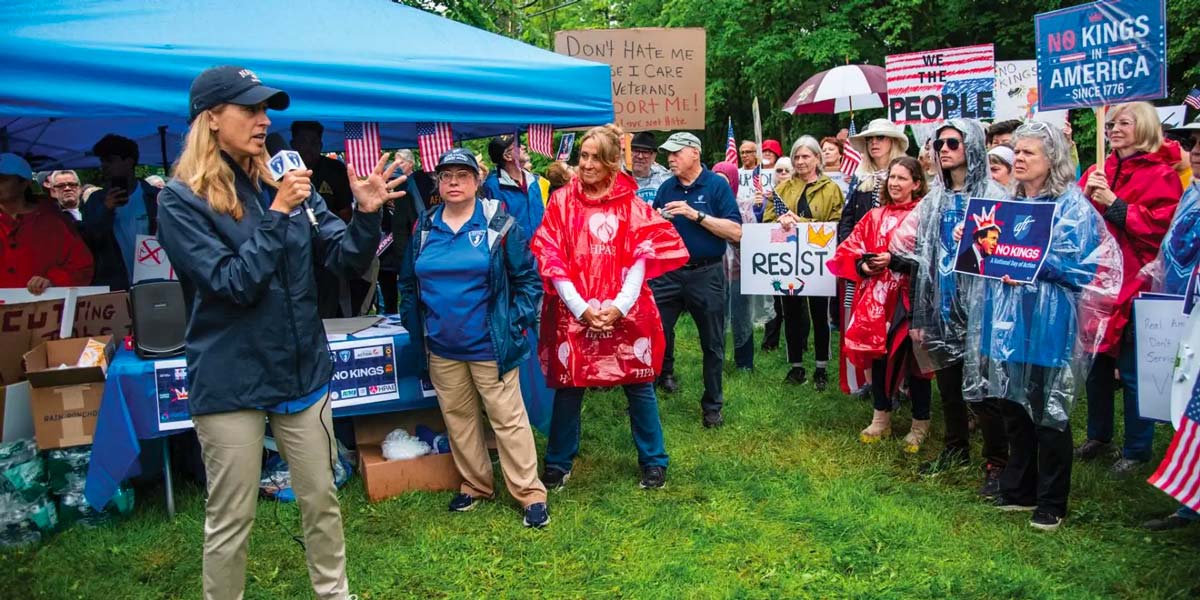
On the one hand, unions are like any other membership organization that people join because of shared interests. If you care about the environment and want more green space in your community, you might join a garden club or local environmental group. Well, if you care about your job and want to make sure you and other workers are treated fairly at work, you start a union or join one that already exists.
But unions have power that few other organizations do because, legally, they can represent groups of members in a workplace and bargain on behalf of those workers over the terms and conditions of work. And the right to do so—the right to form a union and collectively bargain with other workers—is protected under a mix of federal and state laws.14
Unions are also unique in that they are democratic organizations. Locals have constitutions and elections. All of the leaders are elected, including, in the case of national unions like mine, the members electing leaders of their national unions. I am elected to a two-year term by the members of the AFT at its biennial convention. Together, we express shared interests with a shared voice. One of the best examples of this is through collective bargaining, which is the way that unions and the employers they work with arrive at a contract—where the terms and conditions of the working relationship are agreed upon. Whatever the size or strategy, it’s called “collective bargaining” because workers are coming together through their unions to negotiate as a group with employers on work-related issues. And workers have power in those negotiations because of their members joining together as one.
Unions make a powerful difference in the lives of working people. Unions raise wages for their members by an average of 10 to 15 percent.15 Over 9 out of 10 union members have employer-sponsored health benefits and paid sick days, significantly higher rates than for nonunion workers.16 And union workers are more likely to have employer-sponsored retirement plans than nonunion workers.17 Importantly, where there are strong unions, average wages are higher across the board, even for nonunionized workers.18 For every 1 percent more that private workers are unionized, wages for nonunion workers go up 0.3 percent.19 And the effect is even greater for workers without college degrees.
It’s no surprise that fascists don’t like unions. Unions make life better for all working people. Fascists rely on what political scientist Jean Hardisty called “mobilizing resentment,” but that strategy doesn’t work if there’s no resentment to mobilize.20 Fascists need extreme economic inequality to provide the fertile ground for scapegoating immigrants and other vulnerable minorities. And the same playbook used to crush unions is deployed to silence journalists, demonize activists, and suppress voters—because fascism can’t survive in a world where we, the people, have power, information, and opportunity.
Plus, of course, some fascists are oligarchs—or are aligned with oligarchs—who personally reap the benefits of wealth inequality. Elon Musk—the wealthiest person in the world and the top supporter of Donald Trump’s second presidential campaign—has profited by exploiting workers.21 Musk reportedly gloated about his employees trying to impress him by working 20 hours a day and sleeping in the office.22 And a US appeals court ruled that Musk illegally threatened that Tesla workers would lose benefits if they unionized.23 He once said he disagrees with “the idea of unions” because they create “a lords and peasants sort of thing.”24 Labor reporter Steven Greenhouse comments, “That the world’s richest human dissed the idea of unions should certainly be seen as a selling point for unionizing. Musk’s statement shows that he realizes that unions can be highly effective in harnessing the collective voice and power of workers.”25 As a result of Musk’s philosophy, nonunionized Tesla workers earn significantly less than auto workers covered by the United Auto Workers union—in some cases as much as 40 percent less.26 Meanwhile, amid mounting accusations of abuse against workers at SpaceX, Musk filed an audacious suit in federal court arguing that the National Labor Relations Board (NLRB) is unconstitutional.27 This is one of dozens of lawsuits that Musk’s SpaceX, Jeff Bezos’s Amazon, and other corporations have filed against the NLRB.28
Look, no institution is perfect. That’s why I work tirelessly to make the labor movement more effective. But while unions face almost constant scrutiny, wealthy, powerful special interests are often let completely off the hook. For instance, when some of the largest private banks in America made massive mistakes leading to the 2008 financial crisis, they weren’t held accountable. They were bailed out and propped up.29 So bear in mind that when the friends of these bankers and other billionaire special interests attack unions, they don’t really believe in “accountability” in any real sense. They just want to destroy the ability of unions to be a check on their unfettered power.
It’s one thing for business owners or the government to disagree with labor unions about wages and other aspects of a contract negotiation. But attacks on the very existence of labor unions is a hallmark of fascism, as philosophy professor Jason Stanley explains. “Antipathy to labor unions is such a major theme of fascist politics that fascism cannot be fully comprehended without an understanding of it,” writes Stanley.30
“Fascism is most effective in times of severe economic inequality,” explains journalist Spencer Bokat-Lindell.31 But fascism also relies on individuals in society feeling isolated, what philosopher Hannah Arendt called being “atomized.”32 After all, when we don’t know our neighbors, it’s easier for fascist propaganda to turn us against each other. Unions show how our fates are linked and not only deliver better material conditions but make people feel connected to each other and engaged in their lives, jobs, and communities. Labor unions “promote solidarity across differences that fascism depends on exploiting,” writes Bokat-Lindell.33
Unions Strengthen the Middle Class—and Democracy
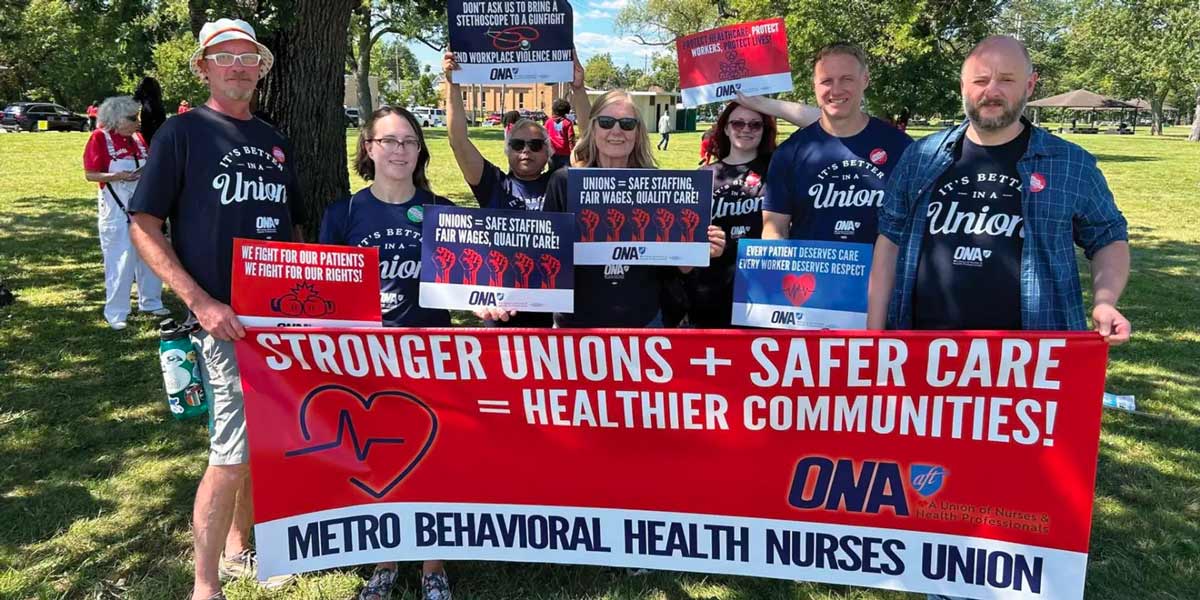
When unions are strong, America’s middle class is strong, too. Between 1985 and 2011, when the proportion of union membership in the United States dropped by 8 percent, the number of middle-class households in the United States also dropped by 8 percent.34 In fact, between 1973 and 2007, data show that anywhere from one-fifth to as much as one-third of the growth in economic inequality in the United States can be attributed to declines in union membership—“an effect comparable to the growing stratification of wages by education.”35
Yet as economic inequality has skyrocketed, and exploitation by billionaires and big business has skyrocketed, support for unions has risen. In 2024, 7 out of 10 Americans had a favorable view of unions—nearly the highest approval rating in 60 years.36 In fact, as confidence in every other major American institution—from the criminal justice system to Congress to TV news to the military—has fallen, trust in unions has increased.37
Unions build the middle class. And unions also build democracy. Historian Heather Cox Richardson talks about how “regular people having agency” is fundamentally disruptive to the fascist agenda that puts all power in a singular authoritarian leader.38 She adds that “people feeling as if they have agency and taking a stand for their rights” is the point of democracy. It’s also the point of the labor movement. Instead of feeling isolated and “atomized” and outside of decision-making—where resentment and even conspiracy theories can fester—union members feel integral to systems of power and clear on their own power to make change. That’s good for all of us as individuals and good for our nation as a whole. Unions practice democracy internally by voting on leadership and contract negotiations. And they strengthen democracy in our nation not only by endorsing candidates but by encouraging people to vote. Union membership increases civic participation. In swing states like Pennsylvania and Michigan, an estimated one in five voters is a union member, and research shows that union members are at least 3 to 5 percent more likely to vote than nonunion members.39
Political scientists Patrick Flavin and Benjamin Radcliff explain that belonging to a union is a form of “political participation in the workplace” that “translates beyond just the workplace and increases a member’s likelihood of becoming involved in the political process and, ultimately, voting.”40 But just like unions boost wages for all workers, not just union members, unions boost rates of voting for all Americans. Even nonunion members living in states with strong unions are more likely to vote.41 Plus, of course, unions take all that agency and engagement and voice and use it to fight for what our communities need. That’s especially true for unions that represent teachers, which fight not only for members in negotiations over wages and benefits but also for what our students need to succeed. And it’s what our nurse locals are also starting to do in our Code Red campaign for patients—raising the alarm about staffing shortages in healthcare facilities.
Voting is the first step in protecting democracy and opportunity, but creating and joining unions is even more powerful for working people—because collective power is the true antidote to authoritarianism. As the labor strategist Michael Podhorzer puts it, “Voting is like going to a restaurant and choosing between entrees on the menu. Collective power is like sitting at the table deciding what’s on the menu.”42 In a true democracy, more and more people have power not just in elections but in deciding how the economy and business and schools and every aspect of society are governed and run. That’s the power of unions. And that’s what truly threatens fascists.
The good news is that unions in the United States are growing, surging in both numbers and popularity. As I’ve already noted, support for unions has grown as Americans have become frustrated by the rise of billionaires and mega-corporations and fed up with leaders like Donald Trump who keep giving more tax cuts and privileges to the super-rich while squeezing the middle class. And unionization has grown, too. In 2021, there were 1,638 groups of employees filing paperwork with the National Labor Relations Board seeking elections to form new unions. But in 2022, 2,510 such petitions were filed—a 53 percent increase.43 Meanwhile, between 2022 and 2024, the AFT organized 185 new bargaining units across the fields of education, healthcare, and public services.44
Authoritarians and the far right fear unions building power because that power is used to make people’s lives better—to rebuild the middle class and ensure that more and more people have access to the American dream. Plus, union power is used to increase wages and pensions and health insurance and other benefits.
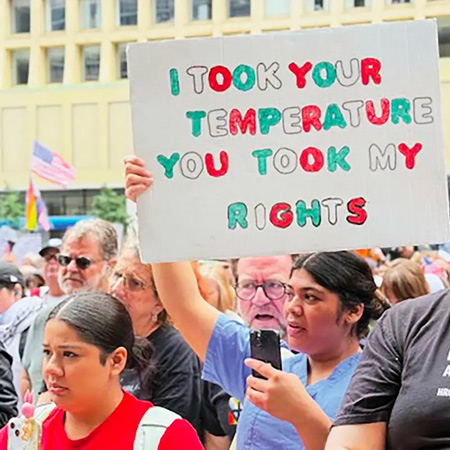 While we don’t yet know everything Trump will do—or try to do—in his second term as president, we know that prioritizing the billionaire class at the expense of ordinary Americans amounts to a great betrayal from the man who sold himself during the election as the savior of the working class. In his farewell address, President Biden issued an urgent—and accurate—warning: “Today, an oligarchy is taking shape in America of extreme wealth, power, and influence that literally threatens our entire democracy, our basic rights and freedoms, and a fair shot for everyone to get ahead.”45
Americans want a better life and more opportunity, not less. They want to be treated with dignity and respect, and they want the same for others, too. From my lifetime of working with Americans across the political spectrum, I know this to be true. We are in a profoundly consequential fight between fear and hope, between anger and aspiration, between chaos and community. And I know, with every fiber of my being, that hope and aspiration and community always win—when we fight for them. Yes, the story of America has included too many dark chapters enabled by our worst impulses. But what makes our nation great isn’t that we’ve always been perfect but that we have fought for justice and have learned from our mistakes—that just as our forebearers forged a new nation to improve upon the one they fought for freedom, so too did our grandparents and our great-grandparents fight to make America more just, more fair, more equitable, more inclusive. An America of boundless opportunity. An America where the next generation has a pathway to the American dream. Just like we, in this moment, must fight for those values and that vision—and educate our children and grandchildren so that they, too, can continue to write the story of America that continues to reach toward hope and aspiration and opportunity and liberty and justice for all.
Randi Weingarten, JD, is the president of the AFT. Prior to her election in 2008, she served for 11 years as president of the United Federation of Teachers, AFT Local 2. A teacher of history at Clara Barton High School in Brooklyn from 1991 to 1997, Weingarten helped her students win several state and national awards debating constitutional issues. Widely recognized as a champion of public schools and a better life for all people, her commendations include being named to Washingtonian’s 2023 Most Influential People in Washington and City & State New York’s 2021 New York City Labor Power 100. This article was excerpted with permission from Randi Weingarten’s new book, Why Fascists Fear Teachers: Public Education and the Future of Democracy, published in September 2025 by Thesis, an imprint of Penguin Random House LLC. Weingarten is donating half of her proceeds from the book to the AFT’s Disaster Relief Fund and Educational Foundation.
Endnotes
1. C. Megerian, “At Mich. Chip Plant, Biden Says Unions ‘Built Middle Class,’” Associated Press, November 29, 2022, apnews.com/article/gretchen-whitmer-biden-technology-government-and-politics-michigan-4d5ac5a4bec5a2e61b4567639240d97c.
2. L. Feiveson, “Labor Unions and the U.S. Economy,” US Department of the Treasury, August 28, 2023, home.treasury.gov/news/featured-stories/labor-unions-and-the-us-economy.
3. History.com, “Slavery in America,” April 25, 2024, updated January 14, 2025, history.com/topics/black-history/slavery; and Brown University, “Colonial Enslavement of Native Americans Included Those Who Surrendered, Too,” February 15, 2017, brown.edu/news/2017-02-15/enslavement.
4. National Education Association, “History of the National Education Association and the U.S. Labor Movement,” July 2025, nea.org/advocating-for-change/new-from-nea/history-national-education-association-and-us-labor-movement.
5. AFL-CIO, “Lowell Mill Women Create the First Union of Working Women,” aflcio.org/about/history/labor-history-events/lowell-mill-women-form-union.
6. A. Shashkevich, “Stanford Project Gives Voice to Chinese Workers Who Helped Build the Transcontinental Railroad,” Stanford Report, Stanford University, April 9, 2019, news.stanford.edu/stories/2019/04/giving-voice-to-chinese-railroad-workers; and C. Fuchs, “150 Years Ago, Chinese Railroad Workers Risked Their Lives in Pursuit of the American Dream,” NBC News, April 24, 2019, nbcnews.com/news/asian-america/150-years-ago-chinese-railroad-workers-risked-their-lives-pursuit-n992751.
7. J. Sahadi, “Why Do We Work 9 to 5? The History of the Eight-Hour Workday,” CNN, September 9, 2023, cnn.com/2023/09/09/success/work-culture-9-to-5-curious-consumer/index.html.
8. M. Schuman, “History of Child Labor in the United States—Part 1: Little Children Working,” Monthly Labor Review, US Bureau of Labor Statistics, US Department of Labor, January 2017, bls.gov/opub/mlr/2017/article/history-of-child-labor-in-the-united-states-part-1.htm.
9. H. Markel, “How the Triangle Shirtwaist Factory Fire Transformed Labor Laws and Protected Workers’ Health,” PBS News, March 31, 2021, pbs.org/newshour/nation/how-the-triangle-shirtwaist-factory-fire-transformed-labor-laws-and-protected-workers-health.
10. S. Donovan, The Fair Labor Standards Act (FLSA): An Overview (Washington, DC: Congressional Research Service, US Congress, March 8, 2023), crsreports.congress.gov/product/pdf/R/R42713.
11. J. MacLaury, “The Job Safety Law of 1970: Its Passage Was Perilous,” Monthly Labor Review, US Department of Labor, March 1981, dol.gov/general/aboutdol/history/osha.
12. National Archives, “Milestone Documents: National Labor Relations Act (1935),” archives.gov/milestone-documents/national-labor-relations-act.
13. National Labor Relations Board, “National Labor Relations Act,” nlrb.gov/guidance/key-reference-materials/national-labor-relations-act.
14. National Labor Relations Board, “National Labor Relations Act”; and Center for Labor and a Just Economy, “Section 1: Building Worker Power in Cities & States: State Constitutions and Public Sector Collective Bargaining Rights,” in Building Worker Power in Cities & States (Cambridge, MA: Harvard Law School, September 1, 2024), clje.law.harvard.edu/publication/building-worker-power-in-cities-states/state-constitutions-and-public-sector-collective-bargaining-rights.
15. US Department of the Treasury, Labor Unions and the Middle Class (Washington, DC: August 2023), home.treasury.gov/system/files/136/Labor-Unions-And-The-Middle-Class.pdf.
16. A. Banerjee et al., Unions Are Not Only Good for Workers, They’re Good for Communities and for Democracy (Washington, DC: Economic Policy Institute, December 15, 2021), epi.org/publication/unions-and-well-being.
17. US Bureau of Labor Statistics, “Union Workers More Likely Than Nonunion Workers to Have Retirement Benefits in 2019,” The Economics Daily, US Department of Labor, October 25, 2019, bls.gov/opub/ted/2019/union-workers-more-likely-than-nonunion-workers-to-have-retirement-benefits-in-2019.htm.
18. Banerjee et al., Unions Are Not Only Good for Workers.
19. US Department of the Treasury, Labor Unions and the Middle Class.
20. J. Hardisty, Mobilizing Resentment: Conservative Resurgence from the John Birch Society to the Promise Keepers (Boston: Beacon Press, 1999), archive.org/details/mobilizingresent0000hard.
21. Agence France Presse, “Musk’s Millions for Trump Make Him Biggest US Political Donor,” Barron’s, December 6, 2024, barrons.com/news/musk-s-millions-for-trump-make-him-biggest-us-political-donor-134ebd08.
22. S. Greenhouse, “Elon Musk Says Letting Workers Unionize Creates ‘Lords and Peasants.’ What?,” The Guardian, December 20, 2023, theguardian.com/commentisfree/2023/dec/20/elon-musk-unions-tesla.
23. Reuters, “Elon Musk Broke Law with Threat to Tesla Workers’ Stock Options, Court Rules,” The Guardian, March 31, 2023, theguardian.com/technology/2023/apr/01/elon-musk-broke-law-with-threat-to-tesla-workers-stock-options-court-rules.
24. CNBC Television, “Elon Musk: I Disagree with the Idea of Unions,” YouTube, November 29, 2023, 02:50, youtube.com/watch?v=sctgA2qa-rA.
25. Greenhouse, “Elon Musk Says.”
26. N. Naughton and G. Kay, “Tesla Workers Still Make Less Than Those at Ford and GM, Even After Raises,” Business Insider, February 9, 2024, businessinsider.com/tesla-pay-vs-ford-gm-uaw-union-factory-workers-2024-2?op=1.
27. Justia, “Space Exploration Technologies Corp. v. National Labor Relations Board et al, No. 6:2024cv00203—Document 43 (W.D. Tex. 2024),” law.justia.com/cases/federal/district-courts/texas/txwdce/6:2024cv00203/1172784245/43.
28. A. Hsu, “Accused of Violating Worker Rights, SpaceX and Amazon Go After Labor Board,” NPR, November 18, 2024, npr.org/2024/11/18/nx-s1-5192918/spacex-amazon-nlrb-labor-board-elon-musk.
29. P. Kiel, “The Bailout Was 11 Years Ago. We’re Still Tracking Every Penny,” ProPublica, October 3, 2019, propublica.org/article/the-bailout-was-11-years-ago-were-still-tracking-every-penny.
30. J. Stanley, How Fascism Works: The Politics of Us and Them (New York: Random House, 2018), 171.
31. S. Bokat-Lindell, “Fascism: A Concern,” New York Times, July 30, 2020, nytimes.com/2020/07/30/opinion/fascism-us.html.
32. H. Arendt, Essays in Understanding, 1930–1954 (New York: Knopf Doubleday, 2011).
33. Bokat-Lindell, “Fascism: A Concern.”
34. E. Robinson, “Do Unions Boost the Middle Class?,” Chicago Booth Review, December 9, 2015, chicagobooth.edu/review/do-unions-boost-the-middle-class.
35. B. Western and J. Rosenfeld, “Unions, Norms, and the Rise in U.S. Wage Inequality,” American Sociological Review 76, no. 4 (2011): 513–37.
36. AFGE, “New Gallup Poll: 70% of Americans Approve of Labor Unions,” September 3, 2024, afge.org/article/new-gallup-poll-70-of-americans-approve-of-labor-unions.
37. M. Podhorzer, “As Go Unions, So Goes America,” Weekend Reading (blog), September 3, 2024, weekendreading.net/p/as-go-unions-so-goes-america.
38. M. Boyer, “AFT Book Club: Heather Cox Richardson on the Future of Democracy,” AFT, October 22, 2024, aft.org/news/aft-book-club-heather-cox-richardson-future-democracy.
39. A. Hsu, “Labor Unions Make a Final Push Canvassing Door to Door in Swing States,” NPR, October 28, 2024, npr.org/2024/10/28/nx-s1-5159947/labor-unions-make-a-final-push-canvassing-door-to-door-in-swing-states; and T. Wang, Union Impact on Voter Participation—and How to Expand It (Cambridge, MA: Ash Center for Democratic Governance and Innovation, Harvard Kennedy School, June 2020), ash.harvard.edu/wp-content/uploads/2024/02/300871_hvd_ash_union_impact_v2.pdf.
40. Wang, Union Impact on Voter Participation.
41. Wang, Union Impact on Voter Participation.
42. Podhorzer, “As Go Unions.”
43. Office of Public Affairs, “Election Petitions Up 53%, Board Continues to Reduce Case Processing Time in FY22,” National Labor Relations Board, October 6, 2022, nlrb.gov/news-outreach/news-story/election-petitions-up-53-board-continues-to-reduce-case-processing-time-in.
44. AFT, “In Address to Union, AFT’s Weingarten Champions Real Solutions for a Better Life, Celebrates Historic 1.8 Million-Member Milestone,” July 22, 2024, aft.org/press-release/address-union-afts-weingarten-champions-real-solutions-better-life-celebrates.
45. New York Times, “Full Transcript of President Biden’s Farewell Address,” January 15, 2025, nytimes.com/2025/01/15/us/politics/full-transcript-of-president-bidens-farewell-address.html.