


November 13, 2026 — When in session each year, the PEF Convention is the union’s highest decision-making body. Delegates consider and vote on various resolutions written by their fellow delegates, and the actions they take amend or establish new PEF policy.
Fourteen (14) resolutions were considered and voted on by delegates at last month’s Convention in Niagara Falls. Five were adopted as printed, five were referred to PEF Departments for further study, three were adopted with amendments, and one was defeated.
Five resolutions were adopted as printed

Resolution 6, Developing Member Competencies for Artificial Intelligence Governance and Oversight, was adopted as printed. The resolution calls for PEF to support individual state agencies that provide education, training and professional development opportunities that prepare members for Artificial Intelligence (AI) governance, oversight, risk management, and remediation as AI is introduced to more agencies across the state. The resolution also asks that the PEF Divisions Department work with agencies and members to identify areas of concern where AI is involved, including bias, fairness, and transparency, as well as develop guidelines and procedures to address those concerns. Lastly, the resolution calls on PEF to affirm that state employees be leaders in ensuring responsible implementation of AI, and that PEF identify the proper departments within PEF to assist the Divisions Department with the implementation of this resolution.
Resolution 22, Advancing Union-Backed Housing Models for PEF Members, was adopted as printed. The resolution calls for PEF to recognize the issue of affordable housing and access to homeownership as a labor and economic justice issue. It resolves that PEF shall work alongside the American Federation of Teachers (AFT), Service Employees International Union (SEIU) and the New York State AFL-CIO to explore and promote union-backed housing strategies. This could include housing set-asides for union members in publicly financed or labor-supported developments, cooperative or union-sponsored housing developments designed for public sector employees and other strategies to support housing for members.
Resolution 21, PEF Fights for Affordability, calls on PEF to work with the AFT, SEIU and state legislators to address affordability issues. The resolution names food insecurity, affordable housing, pensions and medical debt as the major issues facing members. The resolution calls on PEF to educate members about the AFT Fight for Affordability campaign and encourage participation. It also calls on PEF to conduct monthly member surveys to track economic well-being and hold policy makers to account. Lastly, the resolution calls on PEF to continue advocating for wages that keep up with the true rate of inflation, as well as policies that reduce debt and protect Social Security and pensions.
Resolution 20, Growing the Future; AIMing for ACTIVE, INFORMED MEMBERS, calls on the president of PEF to assign members and support staff to an Education and Training Committee to review current training and develop and implement Active Informed Member (AIM) modules to teach members about their rights as a union member. The resolution calls for hybrid trainings (in person and virtual), along with coordination with AFT, SEIU and the AFL-CIO, to supplement training when necessary. The resolution asks that the PEF Executive Board be informed of the resolution’s progress by the “second Eboard after convention” (March 2027) and as part of the board’s quarterly agenda moving forward.
Resolution 3, Ensuring Continuity of Membership and Benefits for Military Reservists and National Guard on Unpaid Military Leave, asks that PEF affirm its commitment to ensuring the continuity of union membership and benefits for members who are military reservists or serve in the National Guard.
Three resolutions adopted with amendments
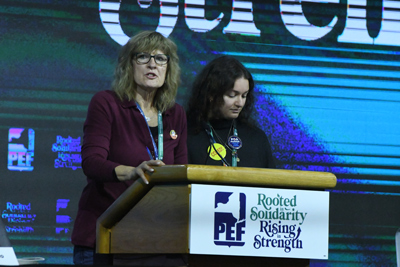
Resolution 32, Health and Safety Compensation, calls on PEF’s Health and Safety and Legal Departments to educate and support members on what additional recourse they have regarding workplace injuries beyond just workers’ compensation.
Resolution 31, Two Grade or Higher Upgrade, requires that PEF use “all internal resources” to secure a two-salary grade upgrade or higher for as many titles as possible.
Resolution 18, Resolution for Opt-In Email List/Directory for Convention Delegates, calls on PEF to utilize an event-specific communication platform that would allow Convention delegates to opt-in or out of an attendee directory and communicate with each other without the use of personal email addresses.
Five resolutions referred to PEF Departments for further study
Resolution 11, Advocating for Hazard Pay for Caseworkers and Counselors Exceeding National Caseload Standards, was referred to PEF’s Legislative Department. The resolution asks that PEF advocate for the implementation of a comprehensive study to determine safe caseload levels for counselors and caseworkers across all relevant titles. Additionally, it calls on PEF to advocate for caseload threshold standards and hazard compensation when caseloads exceed 15-20% above a standard level. Finally, it calls on PEF to advocate for monitoring of caseload standards to ensure sustainability, quality care, and employee well-being.
Resolution 9, Advocating for Compensation Aligned with Educational Requirements for Professional Roles, was sent to PEF’s Civil Service Enforcement/Research Department. The resolution asks PEF to work with New York State to establish minimum salary standards based on educational requirements. Per the resolution, for jobs that require a doctorate, the minimum salary shall be no less than a PEF Grade 26. For a master’s degree level position, the minimum shall be no less than PEF Grade 22. For a bachelor’s degree, the minimum shall be no less than PEF Grade 18. The resolution calls on PEF to review the salary standards periodically if they are established.
Resolution 38, Provide Stewards with an optional preamble at the start of grievances, was referred to the PEF Field Services Department. The resolution suggests union stewards recite an optional “preamble” during grievance meetings, as management often does.
Resolution 13, Workload Expansion, Job Creep, and Sustainable Caseload Standards, was sent to the Legislative Department. Similar to Resolution 11, this resolution calls for PEF to advocate for workload studies. It adds that staffing analysis should also be a part of the study as agencies begin to experience increases in duties and responsibilities. The resolution also adds that these studies should support members seeking classification reviews when duties have changed beyond their existing specifications. Lastly, it calls on PEF to advocate for policies that protect members from excessive workload demands and overtime.
Resolution 14, Amendment to PEF Onboarding Application to Include Division Identification Field, was sent to the Divisions Department. The resolutions calls on PEF to add a field designated for “division assignment” on new hire applications and onboarding documents to ensure new employees are placed within their correct division at time of hire. The resolution hopes to strengthen onboarding consistency and enhance communication between stewards and new members.
One resolution defeated
Resolution 26, Permanently Rescind the NYS HELPS Program and Protect Members Whose Promotional Opportunities/Jobs have been or may be Adversely Impacted by the Program, was defeated at Convention. The resolution called for PEF to send a referendum to the membership, asking them to vote on whether or not the union should take all action, not excluding litigation, to rescind NYHELPS. It also called on PEF to do whatever is necessary, not excluding litigation, to protect members if the State should implement a reduction of the workforce that would specifically harm those who obtained their position via competitive examination and were at risk of being displaced by those who obtained their position without an exam or through NY HELPS.