Tactile panels on display through April 6
March 13, 2026 — For most museum visitors, experiencing an exhibit means looking at it. But what if you are visually impaired, blind, or view the world in a different way?
PEF members at the Office of Cultural Education collaborated to bring mycologist Mary Banning’s world of mushrooms to life for visitors who might not otherwise be able to enjoy it.
A ‘view’ for all
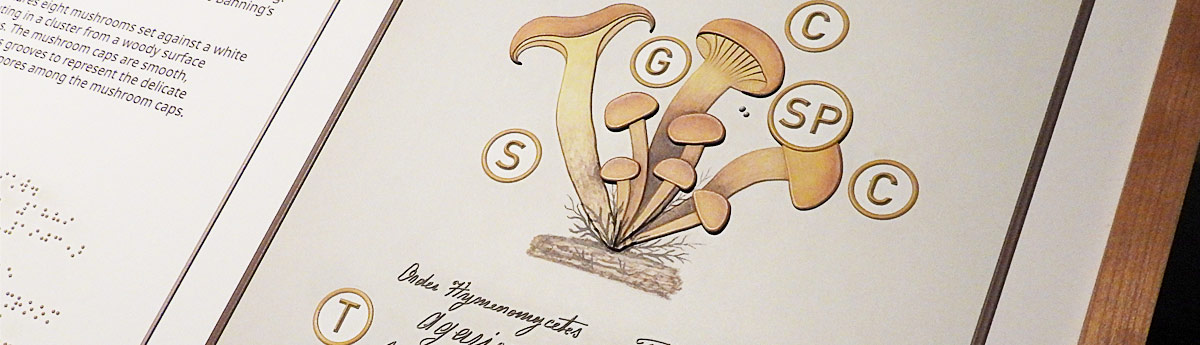
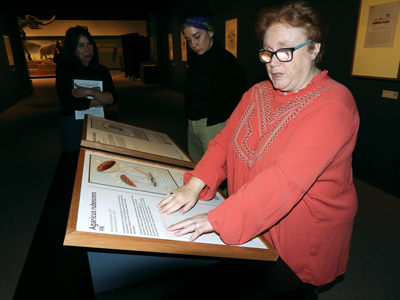 Their work is part of the exhibit Outcasts: Mary Banning’s World of Mushrooms, where a series of tactile panels with braille text and raised elements allow visitors to feel the shapes and textures of mushrooms and experience the information in a new way. The panels complement the exhibit’s vibrant prints and flowing script.
“It was pretty clear that there was no reason for someone with low vision to be at the museum, so we wanted to make sure we offered a lot of fun things to explore,” said Shawn Lemieux, director of the Talking Book and Braille Library. “It was an opportunity to provide accessibility for people who may not always have accessibility, especially in museums where everything is so visual.”
RELATED: PEF librarians help blind and readers with disabilities access thousands of books
Lemieux, who has low vision, said museum visits can sometimes feel underwhelming.
“A lot of times when I’m at an exhibit with somebody, they’re walking through it very fast because they’re looking at everything – and I’m bored because I’m not looking at everything,” she said.
Visitors with low vision fall across a spectrum, she explained, from those who are completely blind to those with limited sight. While Banning’s paintings are somewhat accessible up close, the tactile panels provide even more meaningful interaction.
“What was really fascinating to me is that I know about script writing, but I don’t see it very often. Not because it’s not there, because I just don’t see it. It was really neat to feel it, because on these boards you can feel what Mary Banning’s script looked like, and that’s important,” Lemieux said.
Her handwriting is part of the story of Banning’s work, Lemieux said, and the raised panels allow visitors to feel the script, the outlines of the mushrooms, and their shapes.
 “If you’ve never had interactions with mushrooms, how would you know what one looks like if you’ve never seen one before?” she asked. “If you just look at a picture and you don’thave three-dimensional vision, it still looks flat. But when you feel it, it’s tactile — you can understand what it is.”
QR codes below each painting provide additional information online, including the full text connected to each image.
“I love information, and having the option to access it is golden,” Lemieux said. “I can get on my phone and read about all this neat stuff. It’s really an immersive experience, and I’mso grateful to the team that did this.”
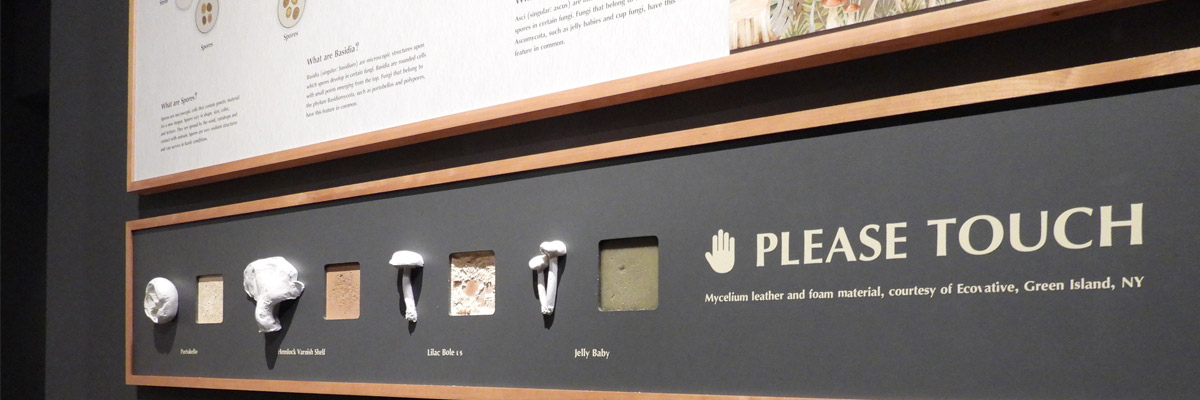
The exhibit also features tactile and audio elements beyond the panels, including a wall where visitors can feel the textures of different mushrooms and listen to a calming nature soundscape.
RELATED: PEF members travel to D.C. to advocate for museums
Museum planner Koren Lazarou said the project brought together PEF members and staff from across the Office of Cultural Education, including the New York State Archives, the Museum’s history department and Research and Collections, and the Talking Book and Braille Library.
“There’s a lot of excitement around making accessible components and features in all of our exhibits going forward,” she said. “Each exhibit is unique and kind of has a life unto itself. This one in particular had a lot of momentum. The content really allowed us to look into all the different ways that people could experience mushrooms.”
While the tactile panels will be removed from the exhibit after April 5, they will remain part of the museum’s teaching collection, and staff hope the project will continue the conversation around accessibility.
The world of mycology
Curator of Mycology Patricia Kaishian said the exhibit also highlights a renewed interest in fungi and the museum’s unique collection.
“There has been a surge of interest in mycology over the last few years,” she said. “The museum is a great place to tell mycological stories because we have a very historic collection of fungi that even major natural history museums don’t have.”
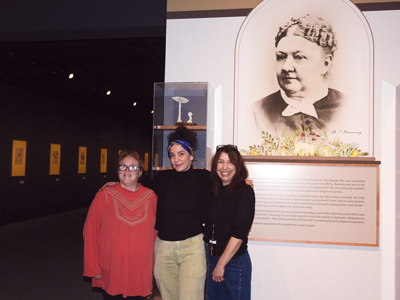
The exhibit centers on Mary Banning, who was born in 1822 and developed a fascination with mushrooms, nature, and drawing early in life. Despite falling into poverty after her father’s death, Banning continued her studies, exploring forests on her own.
Banning created detailed illustrations and descriptions of the specimens she found, documenting their biology and colors at a time when few professional mycologists existed.
One of those professionals was Charles Peck, the mycologist at the New York State Museum. Banning corresponded with Peck for more than 20 years and eventually sent him a manuscript she had spent three decades developing. It included 175 watercolor illustrations documenting the mushrooms of Maryland.
“She’s really funny and had these very lucid, charming descriptions of people that she met in the woods, people who thought she was crazy for doing what she was doing,” Kaishiansaid. “It’s very immersive, it’s very charming, but also deeply serious. She was a really talented specialist, a technical scientist, but she can also move between technical description and very vivid prose.”
Tragically, the manuscript sat in a desk drawer for more than 80 years.
“My predecessor uncovered the manuscript in the 1980s and immediately recognized its value,” Kaishian said. “He helped bring her legacy to life and played a role in getting her inducted into the Maryland Women’s Hall of Fame.”
When Kaishian joined the museum in 2023, she continued that work and sought publication for Banning’s manuscript.
“I am happy to say that it’s being published by Princeton University Press,” she said. “I’m very excited about that. I think she deserves to be celebrated and acknowledged. I had a lot of fun putting this all together. I love that it brings together history, science, art, and the history of women in science.”