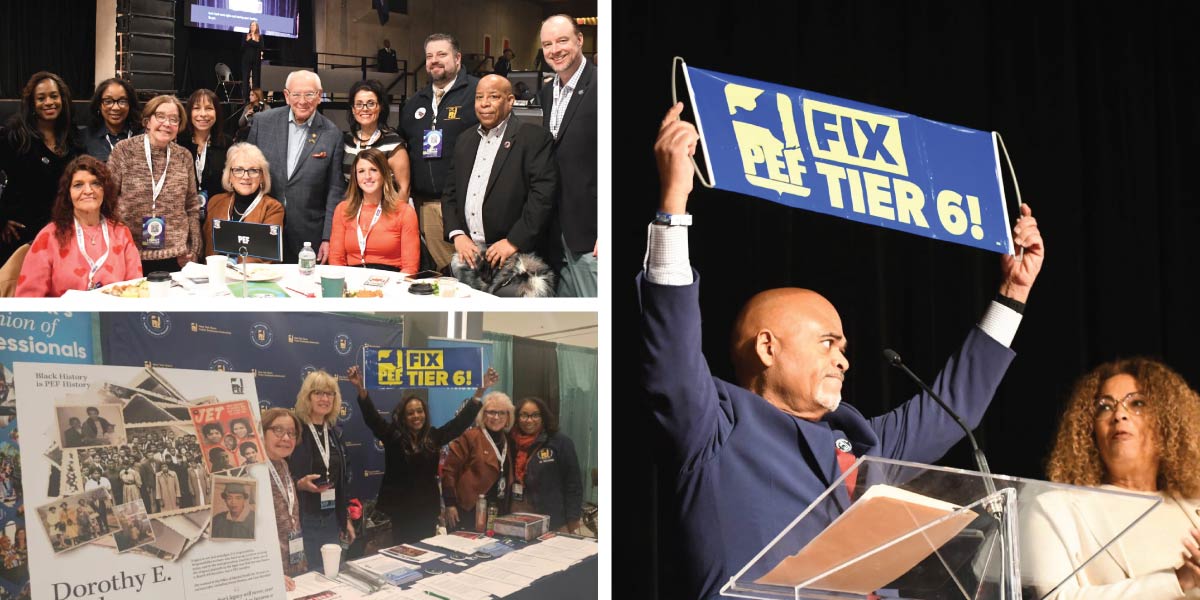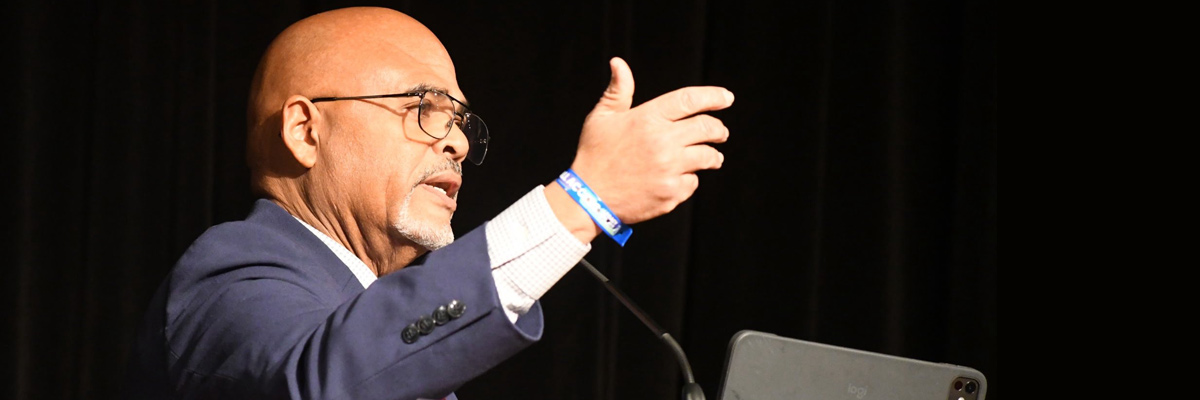
March 13, 2026 — President Wayne Spence gave the keynote address at the 55th Annual New York State Association of Black, Puerto Rican, Hispanic, and Asian Legislators (NYSABPRHAL) Conference in Albany on Feb. 14, reflecting on the legacy of the labor movement and looking forward to building a better future.
“Legacy is often spoken of as something we inherit. But in labor, in civil rights, and in public service, legacy is something we carry,” he told the assembled leaders at the annual labor luncheon the Saturday of the conference. “It is a trust handed down by people who organized when it was dangerous, who spoke when silence was safer, and who built institutions so that those coming behind them would have a fighting chance.”
President Spence recognized the contributions of the late Dorothy Reid, a longtime PEF member who, at 14 years old, helped shape the future of public education as an original plaintiff in one of the five cases that would later become the landmark Brown v. Board of Education decision that forced public school desegregation.
“Dorothy Reid got that education she fought for; she lived her legacy, and for 28 years served the state of New York in various capacities,” he said. Her daughter, Renee Reid, continues that legacy of service as a parole officer and PEF member.
Prison reform
Conditions in correctional facilities across New York remain dire, with understaffing, policies driven by politics instead of evidence, exhaustion, and fear.
“We have had four suicides among PEF members working in DOCCS in two years,” President Spence said. “Something is wrong. Something is broken. New York State correctional facilities are not safe for anyone, not workers and not incarcerated individuals.”
Reform means safe staffing, mental health support, essential rehabilitation programming, clear protocols, and accountability, he said.
Health and safety
When the state cuts corners on safety, the impact is not evenly distributed — it disproportionately falls on Black and Brown workers who are concentrated in the most dangerous public-sector jobs.
“At PEF, we have fought for enforceable protections — not promises,” President Spence said. “For real workplace violence prevention, clear emergency procedures, and a voice for workers in decisions that affect their lives. Because no one should have to choose between serving the public and surviving the job.”
Solidarity
In Brooklyn, unions, clergy leaders and the community united to protect SUNY Downstate Medical Center — a hospital that serves a patient population that is overwhelmingly Black and Brown.
“The health equity gap in this state is real,” President Spence said. “We almost lost the only kidney transplant center in Brooklyn and the only one in any public hospital in New York City.
“Saving Downstate wasn’t just about preserving a hospital; it was about protecting vital healthcare access and equity,” he said. “That victory proves something powerful: When labor stands united, we can take on the biggest fights — and we can win.”
A new threat
Recent ICE activity poses a direct threat not just to immigrant communities, but to labor itself.
“Fear is a union-buster,” said President Spence. “When workers are afraid to report violations, afraid to organize, afraid to show up at a meeting or a rally, that’s not public safety, that’s intimidation. Solidarity cannot be conditional, and justice cannot be rationed.
“Legacy forward does not mean nostalgia,” he concluded. “It means responsibility. I believe when labor, community, and justice move as one, tomorrow is transformed.”