 May 21, 2026 — Exposure incidents at New York State correctional facilities are on the rise. PEF has documented cases at Attica, Clinton, Mohawk, Upstate, Wyoming, and several others. Just last month, a parolee in Queens blew powdered narcotics into his parole officer’s face.
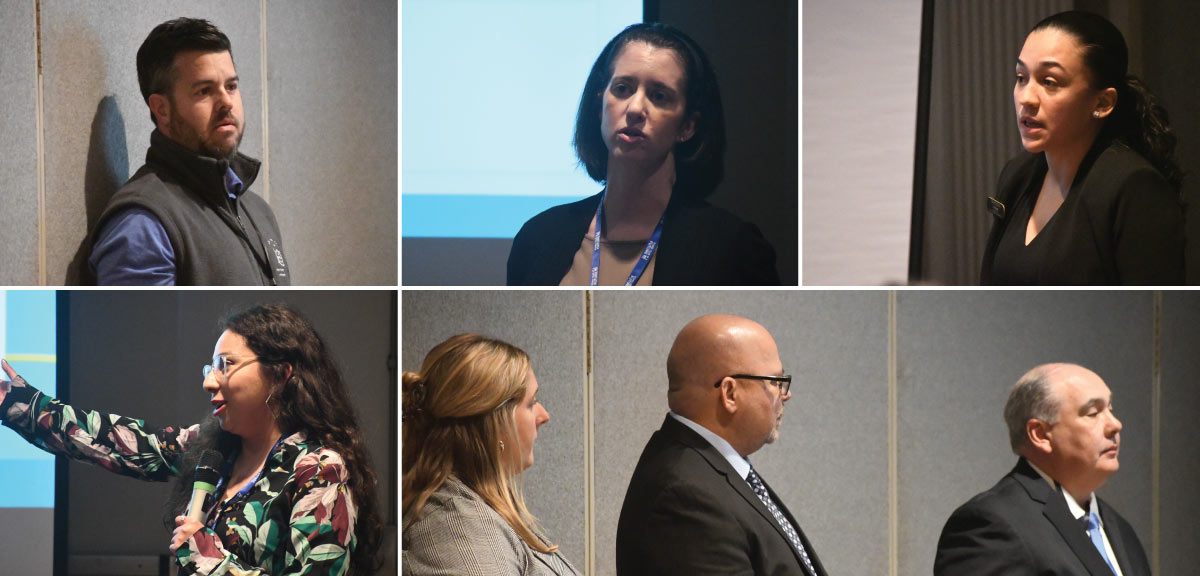
That’s why PEF invited three deputy chief investigators from the DOCCS Office of Special Investigations (OSI) to participate in a workshop at the Health and Safety Conference on May 12 in Albany.
Charolette Lamora, Joe Cavalcante and Sally Flores spoke to PEF members about their efforts to prevent contraband from being smuggled into or distributed inside facilities. The investigators admitted that smuggling strategies are always evolving.
“Obviously we know in the Department of Corrections there’s drugs, and it’s not just in the facility, it could also be in the streets,” said Lamora. “If you’re seeing ways of smuggling or if we’re missing the mark on something that your people are reporting to you, we need to know. Our units rely heavily on the boots on the ground and people in the facilities passing us that information.”
One of the most common ways drugs get into facilities is through legal mail or through soaking paper in substances. The investigators also showed examples of drugs hidden in everyday items like snack boxes, bags of chips, and a pair of headphones. Other recent smuggling techniques include throwing contraband over fences or walls and even using drones to fly over perimeters and drop packages.
DOCCS has used full-body x-ray scanners, 3D imaging technology called MailSecur, and air filtration systems to help mitigate the risk of exposures, but unknown substances still manage to make it in.
K9 units can help
Deputy Chief Investigator Sally Flores works specifically with the K9 unit. She said that there has been a push for more drug-sniffing dogs inside the walls. It’s a push welcomed by PEF President Wayne Spence, who sent a letter in April to DOCCS Commissioner Daniel Martuscello urging more canine deployment to help address the exposure problem.
“We currently have 33 K9 teams, 31 drug dogs and 2 E-Dogs,” said Flores. “We have other states that are trying to mimic our canine program because our canine handlers are not just canine handlers. They’re also investigators, so they take their own cases on recovery and they’re working that case to see how it came in.”
Currently, the drug dogs are imprinted on six drugs that are common in correctional facilities: Buprenorphine, Marijuana, Heroin, Cocaine, Methamphetamines and Synthetic Cannabinoids.
Last year, the K9 unit made 219 arrests and seized about 50 pounds of marijuana across the State, nearly eight pounds of synthetic cannabinoids, and hundreds of other illegal items, including heroin, cocaine, and weapons.
E-Dogs, Flores said, are specially trained to search for anything that has a memory card, like cell phones. Memory cards have a specific powder compound that prevents them from overheating, which e-dogs are trained to find.
In addition to prevention and seizure, OSI handles investigations. The Criminal Investigations Division investigates drug distribution, possession, and other criminal activities. They also work with other agencies and federal law enforcement to assist with prosecutions when necessary.
“We develop intelligence on how the drugs are coming in and try to find the source inside and also the source outside,” said Lamora. “We respond to and investigate suspected exposures. One of the things we’re combating is when someone is exposed but there is no substance found, so we try to find out what you touched and interview witnesses and staff.”
Toxicology reports, said Lamora, are very important when dealing with exposure to substances. Lamora and her team recommend requesting a full toxicology assessment following any incident.
An ounce of prevention
The workshop also explored preventative measures as well as responses in the immediate aftermath of potential exposure.
The OSI team said that all correctional facilities should have personal protective equipment (PPE), including N95, N100 and P100 respirator masks, nitrile gloves, eye protection and disposable coveralls. They should be available in all sizes and used during potential exposure events. Additionally, Fentanyl Response Kits are stored in mailrooms, package rooms, drug testing rooms, housing units, the Watch Commander’s office, and anywhere else a facility deems appropriate. If there are any issues with these items, PEF members should report them immediately to management.
In the event of an incident, on-the-ground teams, which may include OSI staff, will perform “risk assessments” to figure out how best to keep people safe. Level 1 incidents are the lowest, where medical emergencies may occur but with no known drug presence.
“That is the most common (incident) that we’re investigating,” said Lamora. “The protocol is to minimize contact with unknown materials, avoid contact with face, eyes, nose and mouth, and maintain situational awareness for escalated signs like visual powder or unknown odors.”
At Level 2, there is awareness of an unknown powder, suspected fentanyl or other residue or paraphernalia in proximity to the emergency.
“The PPE requirements here are the respirator, full disposable coveralls, nitrile gloves, eye protections and goggles,” said Lamora. “We isolate the area, restrict access, keep response to staff at a minimum, notify emergency medical and environmental response teams, and follow full decontamination and report procedures.”
At the end of the workshop, the team introduced Matthew Altman, an Associate Industrial Hygienist with DOCCS, to reiterate the importance of ensuring PPE is available. He said that facilities should have the same training and controls in place and have assistance from PESH whenever there is a potential exposure.
“Hazard assessments are part of what we do at DOCCS following an incident. This is an OSHA (Occupational Safety and Health Administration) requirement that follows down into PESH (NYS Public Employee Safety and Health). We have to know and identify where our hazards are,” said Altman. “It also documents what PPE is available in each area. Anywhere we have a response kit, we have a hazard assessment.”
The workshop closed with a brief question and answer period, where members sought clarification on how best to protect themselves during an exposure.
Editor’s note: The slide deck from the presentation can be viewed, here.