
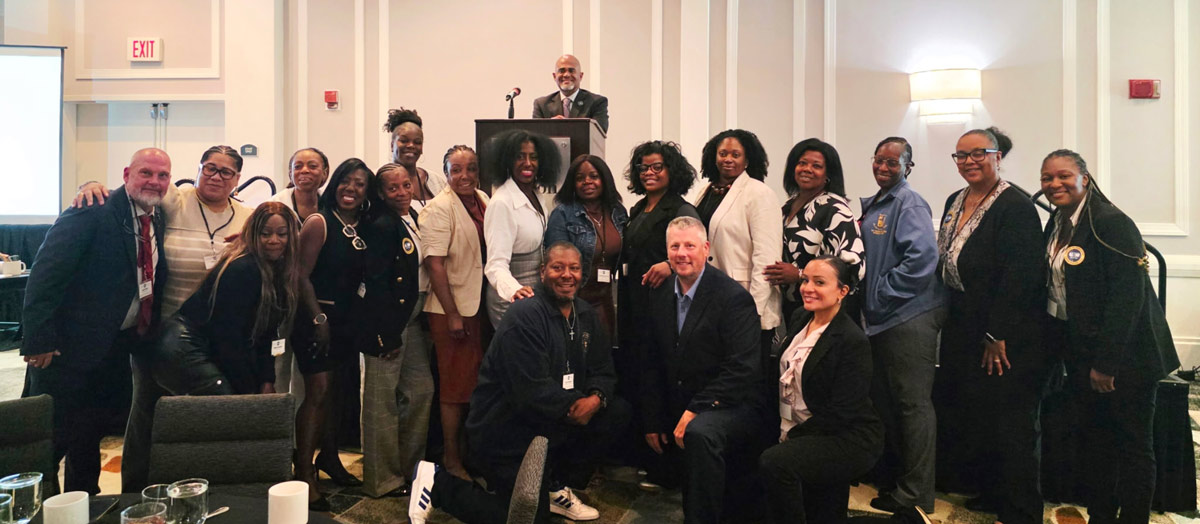
 October 9, 2026 — More than100 PEF members and members of management at the Department of Corrections and Community Supervision (DOCCS), including Commissioner Daniel Martuscello III, met in Albany Sept. 23-25, 2026, for a 3-day conference to discuss the issues facing members who work both behind the walls of correctional facilities across the state and outside the walls with formerly incarcerated individuals. This conference has been a tradition for many years, with DOCCS being the only agency willing to hold a joint conference with PEF. This year, PEF members who work for the Office of Mental Health (OMH) in Corrections-Based Operations and managers from OMH attended for the first time.
PEF President Wayne Spence welcomed attendees alongside PEF’s DOCCS Labor-Management Chair Lori Greenizen and PEF Statewide Director of Field Services Katie Vorwald.
President Spence said that meetings like these are important, not only because they continue to move conversations from Labor-Management into action, but also because having earnest conversations about mental health, physical health, and all the issues faced by PEF members who work at DOCCS help them heal and find solutions.
“I want to tell you that because of the things I’ve been hearing and reading, I have been concerned about your well-being — physical and mental,” President Spence said. “So we have been engaging more with commissioners, with management, with groups like One Voice United (OVU) and with the Correctional Association of New York (CANY).”
Partnerships like the ones with OVU and CANY, said President Spence, that are helping members discover ways of dealing with the stress of working for DOCCS, develop new solutions to issues at workplaces, and even craft and support legislation to change things at the agency.
The conference included a panel discussion with President Spence, Parole Officer and Council Leader for PEF Division 236 Gina Lopez, Founder of OVU Andy Potter, and OVU Senior Advisor Simon Greer, as well as the President of the New York State Correctional Officers & Police Benevolent Association Chris Summers. During the panel, Lopez said that many parole officers have felt sidelined following the former Department of Parole’s merger with DOCCS in 2011.
“It is important to understand that we are part of the same system and deal with almost the same issues,” said Lopez. “While you are working with incarcerated individuals inside the facilities, we are working on making sure they don’t end up back inside. And a lot of that can be tough for us.”
Lopez pointed out that through OVU, PEF parole officers have been able to seek avenues to address their mental wellbeing and access wellness training through a partnership with Desert Waters Correctional Outreach.
Each panelist agreed that while they take steps to try to combat issues around mental health and take as much care for their physical health as possible, some stress is hard to shake and they have erected “walls” that seem normal to them, but have alienated family and friends.
“My family has said to me that they’ve missed out on doing things that normal people do,” said President Spence. “It has taken me years to get comfortable with choosing a seat at a restaurant that doesn’t have my back facing a door.”
The panelists all agreed, however, that despite the issues they face separately, they have accomplished more working together.
“You’re never alone, and you’re all family now,” said NYSCOPBA President Summers, whose union represents corrections officers. “I hope that what I say to my members resonates with you all. Which is that when you’re feeling alone, upset or need to talk, you can reach out to me.”
PEF staff held discussions centered around how to use the contract to enforce grievances on out-of-title work and what tools are available to members to help protect themselves from chemical exposures and other hazards on the job.
Exposure to hazardous or unknown chemicals are common inside facilities, and in some cases outside facilities with parole officers. However, PEF Health and Safety Director Josh Kemp said that PEF members should not accept that as normal.
“These things are not part of the job, they’re not normal,” said Kemp. “But there’s also not enough people reporting it when it happens. We’re pretending that this is normal and it’s not. It’s harmful.”
President Spence said that about 2 percent of staff who work in facilities are likely to report strange smells, potentially harmful hazes, and even fires.
“You may not be sick now, but we know that sometimes long periods of exposure show negative effects later,” said Kemp. “Not reporting puts so many people at risk.”
In addition to filing Public Employee Safety and Health (PESH) complaints, which can often trigger inspections, investigations, violation citations and potentially fix whatever issues are reported, PEF members are encouraged to fill out a Protest of Assignment (POA) form, which gives the member the right to work elsewhere in a facility away from the hazard.
“You cannot strike under the Taylor Law,” said Kemp. “But what you can do is tell your supervisor or manager that there is a hazard and you need to be moved somewhere else to work until the hazard is clear.”
POAs are protected under PESH. PEF nurses and other healthcare professionals widely use them, and the data collected is a big help when it comes to documentation of what is happening, where, and how often.
This advice was especially important for OMH members who work in Corrections Based-Operations, or CBOs. These members are often tasked with providing mental health services to members. Kemp said it is implausible to think that members can do the work of ensuring that incarcerated individuals are safe while both staff and those they serve are inhaling fumes or other potentially harmful substances.
On the second day of the conference, PEF invited DOCCS administration to an open forum with PEF leaders who sit at the Labor-Management table. This was a chance for members to hear directly from Commissioner Martuscello. Ahead of the question-and-answer session, the commissioner took a moment to show videos of retrofitted classrooms within facilities that now have protective barriers around teachers while they engage with incarcerated individuals, as well as doors that open for quick access to the on-duty correction officer or National Guard member in case of a dangerous situation where a teacher needs to leave the area.
“I want to thank you all for the incredible work and the hard work that you do,” said Martuscello. “I want you to know that I’ve been listening to your members and others who have been in discussion with me ever since the assault at Lakeview.”
Some members questioned the barriers themselves, as well as the policies in place that move incarcerated individuals. Under the Humane Alternatives to Long-Time Solitary Confinement (HALT) Act, when an incarcerated individuals needs to be removed from general population due to behavior issues, they are moved to other units like the Residential Rehabilitation Unit (RRU). Many, including Commissioner Martuscello, said they believe individuals are misbehaving in order to be moved to the RRU, or other units.
Members also asked questions regarding retaliation at DOCCS, protections and prosecutorial steps taken against individuals who assault staff, requiring basic training for nurses who work at DOCCS, and more.
Members wanted answers for why it appeared correction officers were given pay increases following the wildcat strike in February 2025. The commissioner said that many were fired and that the reallocation was in the works 18 months prior to the strike.
“That request was sent to Class and Compensation and the Department of Civil Service rendered a decision three months after the strike,” said Commissioner Martuscello.
For PEF Senior Parole Officers, pay was also on theirs mind—specifically Hazard Duty Pay, which Senior Parole Officers do not receive. Senior Parole Officers have been advocating to either receive hazard pay like parole officers or be removed from potentially dangerous situations that they believe require them to be paid the extra money. For Commissioner Martuscello, that means proving they are working half their job or more in hazardous situations. The officers believe they can prove that. The commissioner disagrees.
“I have not seen any evidence that shows that senior parole is doing the work at that 50 percent rate,” said Commissioner Martuscello. “And I am not convinced that they are or that they will have that evidence.”
PEF members in attendance said that they did not feel confident in the answers provided to them by Martuscello, and while they are grateful for his attendance, they hoped for more assistance and guidance.
“I don’t feel that I have the confidence going forward to do my job, although that discussion was great and needed to be had,” said Donna Gieycki, a vocational instructor at Orleans Correctional Facility.
At the end of the conference, once members had a chance to debrief and share final thoughts, President Spence made sure that the members did not go home without a word of confidence and gratefulness.
“To every member of DOCCS, Parole and to my OMH brothers and sisters, we say thank you,” said President Spence. “You do work that most of your friends and your neighbors and the public do not know about. It needs to be said loudly and as often as possible: Thank you for the work that you do.”
